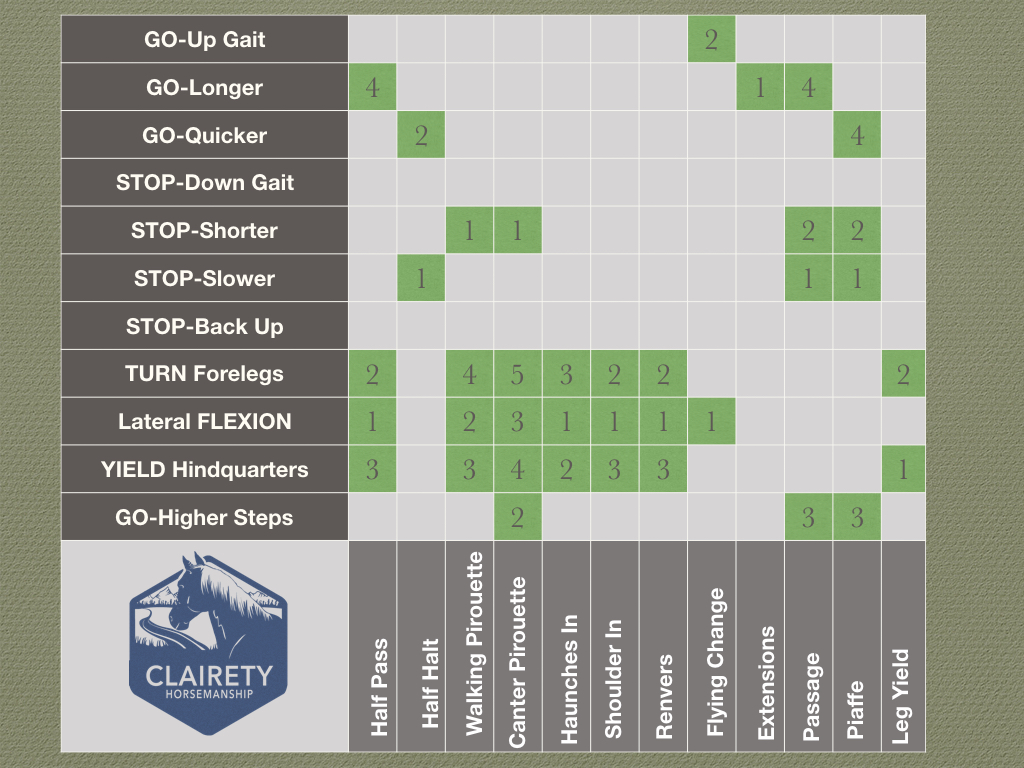
All you need to do any dressage movement through Grand Prix is 11 individual basic responses, cued one at a time in a certain order. Each movement is build using a different order or combination of responses.
You don’t need a fancy dressage horse to learn how to do this! Just start with the movements with the fewest basics: the half halt, and leg yield. Then move on to combining three basics with the shoulder in, haunches in, and renvers. Increase the complexity as you increase your and your horse’s ability.
Today we’re talking about the secret to making a horse listen to you, even if your feet won’t reach the stirrups. Hint: You don’t have to try to get big and strong. You can use this trick even if you’re little!
Can’t I ride a pony today? He’s closer to my size, it would be easier. I wish I’d grow faster! The horses won’t do anything for me, I need to get stronger.
I often hear this from little students. And I feel for you, I really do, but those solutions aren’t actually that helpful! Remember, I used to be the little kid with legs that seemed too short to do anything. But no one told me about this…
It’s not strength you need, it’s timing.
The Pin
Let me ask you a question. When you sit on a pin, why do you get off? Answer that poll for me quickly!
If you answered, because it hurts, you’re not alone. Most people answer that way at first. But think of it this way: the pain of sitting on that pin is actually only the motivator for you to try SOMETHING—anything—to make the pain stop! You might wiggle in your seat (oh that hurts more). You might squeal (that didn’t change a thing). And then you try getting up (ah, relief!) The pain isn’t what made you get off. It’s only because it STOPPED hurting when you got off that you knew that was the effective solution.
Horses work the same way. They learn by sequences.
Horses Learn From Sequences
Think of that pin from our last example. In the same way, pressure is one thing that motivates horses. Horses try to avoid pressure like water tries to avoid obstacles. Pressure can include physical pressure like our reins or legs or sounds, but also psychological pressure like uncertainty or confusion. What if the pain from the pin had went away when you screamed? Well that’s what you would do then right? Horses are the same. Whatever removes the pressure is what they will do again. So when you are squeezing and kicking and your horse isn’t going, it isn’t because you aren’t squeezing hard enough. It’s actually because you don’t STOP squeezing when you should! Maybe you stop too early, before the horse did what you asked. Or maybe you stop too late, long after the horse tried, and then gave up.
The secret to getting your horse to listen to you is learning your timing and getting it perfect.
You don’t have to be big and strong. All you need is perfect timing.
Do This to Get Your Horse to Listen to You
Start with please
Add motivation
Say THANK YOU
…every time.
To improve your timing, follow this sequence every time you ask your horse to do anything. ANYThiNG! From walking with you out of the field, to moving over in the tie stall, to turning a round circle in the arena, to jumping a 4’ oxer. Use this for everything.
Start with please. Use a light, but distinct, pressure cue. Only do as much as you want to have to do every time. If you start with a big kick, you’ll always have to start with a big kick, and no one likes that. Start with the smallest pressure you can that is still distinct so the horse can tell you are wanting something and not just wiggling.
Then, if the horse does not respond right away, add motivation. Motivation can be increasing pressure, but little legs can’t always do that. Increase what you can, but remember that being annoying is motivating too! Just keep at it and don’t give up.
Even though you are concentrating on adding motivation, pay careful close attention to what your horse is doing so you can say thank you at the right time. At first, just look for even a try in the right direction. Maybe your horse won’t move forward at all—you’ll say thank you to him for putting just one foot only one inch forward. To say thank you, immediately drop all pressure, and you can add a nice scratch in an itchy spot or a bit of food too.
Do this every single time you ask for anything. Little by little, your expectations can increase. With the case of that horse that won’t go forward at all, you’ll find after some repetitions of this that he’ll move his one foot one inch forward when you say please! Well done! You’re a horse trainer! Now you’ll increase your expectations and add motivation until you get two steps and immediately give a nice enthusiastic thank you. It won’t be long before you’re trotting all around that arena. Not because you kicked harder, but because you got your timing right.
Assignment
Here’s an assignment for you.
Practice the Listening Sequence. Cue a simple movement—don’t forget to say please! Start with something like backing up a step, or walking forward a step.
Add motivation. Don’t stop asking until he at least tries.
Say thank you! The moment he gives it a try, quit all your cueing and motivation, and add some reward.
Repeat at least three times. Even better, count how many times you need to follow the sequence before your horse responds to your ‘please’! Most horses learn to listen to ‘please’ in the first 7-10 repetitions. Then come back and let me know in the comments how long it took your horse to start listening to you when you said please—all because you started saying thank you!
We will be exploring the ‘first principles’ of equitation science that relate to how horses learn, principles 5-10.
Remember, first principles are the assumptions or concepts behind a scientific theory. Equitation science is based on a few different scientific theories, so we have a few first principles to look at. Understanding these gives you the theoretical base to understand everything else I talk about!
The principles we are talking about today do not make up a horse training method. It is not copy-written like so many of the popular trainers’ methods today. These principles simply explain why and how horse training methods work (or don’t) so we can choose the most effective and ethical way to train a particular horse to do a particular behaviour.
Let’s get into the last six ‘first principles’.
5: CORRECT USE OF HABITUATION/DESENSITIZATION/CALMING TECHNIQUES
Principle 5 is about teaching a horse not to react to things. There are five habituation and desensitization techniques, four of which can be used ethically.
Systematic desensitization is what happens when a horse lives next to a highway and gets used to heavy traffic. At first it may run away from the road when load vehicles drive by, but soon it stops reacting to vehicle noise. This method is effective for most environmental applications, but because flight behaviour can be involved, a horse that is systematically desensitized may spontaneously recover fearful behaviour, given the right situation. When managed carefully in a training setting, the fear threshold can be avoided.
Overshadowing distracts the horse from the fear-inducing stimulus by using a previously trained response. Horses can only focus on one thing at a time, so cuing and repeating a simple response in the presence of an aversive stimulus allows the horse’s brain to accept the aversive stimulus as non-threatening. The stimulus is then moved closer and the process repeated.
Counter conditioning takes an event or object that the horse perceived negatively and associates something positive with it. Food is often used in this technique.
Differential reinforcement is a highly useful technique that helps riders avoid punishment. The trainer simply ignores behaviour that is not wanted, while rewarding preferred behaviour. This works extremely well for any behaviour that is not directly dangerous to the handler.
Flooding is the fifth habituation technique, and it should be avoided. Flooding occurs when a horse is completely helpless to escape the aversive stimulus. The horse will eventually give up, and the trainer thinks he has achieved what he wants. The horse, however, has an incredible fear memory and is likely to have an extreme reaction to that stimulus in the future unless it is restrained again. The other possibility is that the horse will enter the spectrum of learned helplessness. Neither outcome is a good or helpful one.
6: CORRECT USE OF OPERANT CONDITIONING
Principle 6 is about operant conditioning.
You can remember the term ‘operant conditioning’ by remembering that something is ‘operated’ on the horse. Something is either added to the horse or taken away from the horse to influence behaviour.
Reinforcement makes a behaviour more likely in the future.
Punishment makes a behaviour less likely in the future.
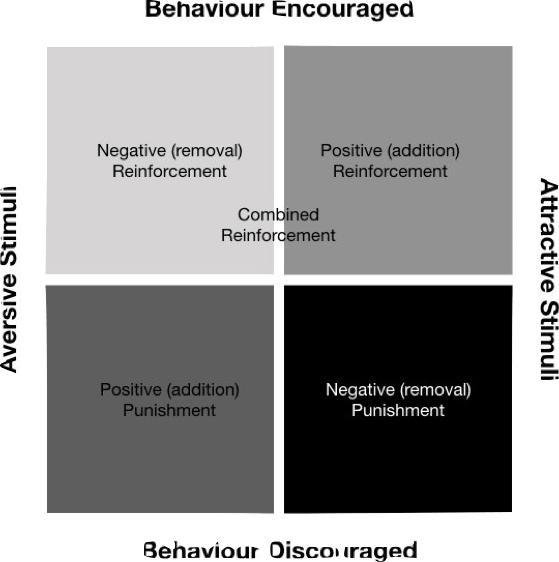
Operant conditioning is best explained with a picture. Things the horse doesn’t like are on the left, called Aversive Stimuli. Things the horse likes are on the right, called Attractive Stimuli. Both aversive and attractive stimuli can encourage behaviour (see the top quadrants) or discourage behaviour (in the bottom quadrants).
Horses learn best through reinforcement, and punishment is best avoided.
Reinforcement can be negative in the mathematical sense of the word, where something the horse doesn’t like is removed or subtracted in order to make a behaviour more likely in future.
Reinforcement can be positive in the mathematical sense of the word, where something the horse does like is added in order to make a behaviour more likely in future.
Combining both types of reinforcement together is highly effective and is called combined reinforcement.
7: CORRECT USE OF CLASSICAL CONDITIONING
Principle 7 is classical conditioning, which was made famous by Pavlov’s experiment. He trained dogs to salivate when he rang a bell by consistently ringing the bell before feeding the dogs. Soon, the bell predicted the food, and the dogs got ready by salivating.
When the phone rings and you answer it, or you hear a car door outside and know dad is home, or the smoke detector goes off and you get out of the house, you are responding to classically conditioned cues. The cue itself could mean anything. A phone ringing is a neutral sound, as is a car door, or the loud beeps of a smoke detector. We know what those sounds mean based on what happens immediately after them. The phone rings, and a relative is calling. The car door closes and a moment later dad walks into the house. The smoke detector goes off and then you see fire. We are trained to understand the sound by the sequence of events that follows.
Horses are incredibly good at learning sequences of events. The rider walks into the tack room after tying the horse up and he starts to paw, predicting that the rider is about to come back out with a bucket of food because that is what has happened hundreds of times before.
This trait in horses is very handy for teaching both vocal cues and incredibly light pressure cues. The lighter the cues can be, the happier the horse and the funner the ride.
When handling a horse, always use light pressure first and escalate, rather than starting with a firm pressure.
Classical conditioning is the most common culprit when a rider accidentally trains their horse to do something. Walking away from the mounting block is a common example. The sequence of events is, the rider gets on and then tells the horse to go. Pretty soon the horse is going as soon as the rider puts his foot in the stirrup. Understanding how to use classical conditioning prevents misunderstandings like this.
8: Correct Use of Shaping
Principle 8 shows how horses progress from basic training to advanced training.
Shaping is what transforms a behaviour from a basic movement to the most complex and physically challenging behaviours that people can train horses to do. Using the shaping scale developed by Equitation Science International gives a roadmap for how to develop a behaviour from first try to final, reliable result.
Picturing in your mind what your end goal for a behaviour is, and then planning out small, incremental steps to get there is an effective training strategy.
Start with only expecting the horse to try something that resembles what you want in the end. It will be far from perfect, but you will still reinforce the behaviour.
The horse quickly moves to obedience level, where the behaviour is given immediately to a light cue.
Then the trainer requires the horse to maintain the behaviour a bit longer to receive reinforcement, establishing a rhythm.
Then the behaviour must be maintained on the path you chose in order to be reinforced; this is straightness. At contact level, the horse can be trained to maintain a particular posture while performing the behaviour. Lastly, all the previous criteria for the behaviour can be trained to occur in any place, which is the proof that the training is complete.
9: CORRECT USE OF SIGNALS/CUES
Principle 9 explains how horses perceive signals.
Many things can be used to cue a horse: voice, posture, facial expression, body language, reins, hands, legs, sounds, whips, spurs, and more. Anything used as a cue must be used as a signal, not as a punisher. Remember, horses do not learn well from punishment.
Each signal for a different behaviour must be unique so the horse can distinguish what behaviour is being cued. Each signal may only mean one thing. That may seem obvious, but many riders will use their lower leg to tell their horse to speed up, and also use their lower leg to cue a turn. It is a good idea to take inventory of what cues you use with your horse and ensure they are not confusing.
Two signals must never be applied at the exact same time. Horses can only process one thing at a time. Asking for two things will mean that one of them gets overshadowed, like we learned in Principle 5. Many instructors teach to half halt by using simultaneous rein and leg pressures. This will desensitize the horse to one or both cues. It is much better to apply one cue and achieve a response and a moment later apply the next cue. With shaping, cues can safely be paired very close together.
The best riders are well versed in biomechanics and can time their cues to the most appropriate time in the horse’s stride so the correct behaviour is easy for the horse to give.
10: REGARD FOR SELF-CARRIAGE
Principle 10 applies to all the other principles, which is why it is last. At every stage in training, the handler should make sure that the horse is responding on its own. That is, the trainer is not forcing the behaviour, or physically maintaining the behaviour for the horse. When a horse is in self-carriage, or maintaining the correct speed, direction, posture, and whatever else is being trained, the horse can be relaxed.
Riders who ‘nag’ produce horses that are dull or begin to shut down.
Riders who prioritize self-carriage produce horses that are relaxed, willing, and responsive. Both horse and rider benefit!
CONCLUSION
Understanding these principles gives you an understanding of how your horse works on the inside, allowing you to communicate in a way that makes sense to him. Which principle gave you the biggest a-ha moment?
The first principles of equitation science is the best place to start when trying to understand your horse. What is a first principle? First principles are the assumptions or concepts behind a scientific theory. Equitation science is based on a few different scientific theories, so we have a few first principles to look at. Understanding these gives you the theoretical base to understand everything else we will talk about on this channel.
Today we will look at the first four ‘first principles’. These are what I call the ‘horse principles’ and they apply to any horse. The second set of ‘first principles’, that I call the ‘training principles’, deal more with the specifics of training. We will look at the those in the next post.
Equitation science is not a horse training or teaching method. It is not copy-written like so many of the popular trainers’ methods today. It seeks to define and study the parts of the relationship between people and horses that can be measured and defined. This includes learning theory, ethology, and biomechanics. Learning theory explains how horses’ brains process information to learn from it, enabling us to train them more effectively. Ethology describes each of the behaviours that horses exhibit, allowing us to understand what is normal and how to care for horses according to their needs. And biomechanics studies how horses move, allowing us to become better riders.
Some aspects of a relationship between horses and humans are difficult to scientifically define, like ‘feel’ and ‘trust’ and ‘respect’ which are words often used in the natural horsemanship methodologies. Some people don’t like that equitation science does not address these things, but they are simply not within the scope of what equitation science seeks to clarify. ‘Trust’ and ‘respect’ cannot be measured scientifically with any kind of empirical experiment, so equitation science does not speak to it. The goal of equitation science is rather to study what is measurable and definable so we can apply it to our daily interactions with horses and make the experience more positive for both us and the horse.
Let’s get into the first principles.
Principle 1: Regard for Human and Horse Safety
Knowing how something works is the first step to using it properly. Take a kitchen knife for instance. A knife can be dangerous if used improperly. If you don’t know which side is sharp, you are likely to cut yourself by accident instead of slicing your cheese. In the same way, if we study how horses work, and how they are different from us, we are less likely to run into dangerous situations.
We know that horses are flight animals. Their preferred reaction to fear is to run away. If they cannot run, they may freeze or fight. Recognizing when a horse is scared and being able to defuse the fear or deescalate the situation keeps you safer, and helps the horse to relax.
One of the biggest parts of planning my lessons is choosing which student gets to ride which horse. Matching rider ability and personality to horse training level and temperament is very important for safety. Ensuring the horses are tacked up correctly and the arena is clear of hazards is also part of my job.
Lastly, confusion worries horses. When a rider gives an ineffective cue, or conflicting cues, the horse becomes confused and this can build up into frustration and unwanted behaviours like aggression, ears back, biting, kicking, bucking, and many more. The goal of every rider and horse lover therefore should be to understand better how horses work from the inside out, giving the horse a sense of security, keeping both horse and rider safer.
Principle 2: Regard for the Nature of Horses
Because horses are horses, they have certain social and welfare needs that we need to do our best to meet.
They require companionship of other horses. They require the ability to forage for food, and to move around. They need to create herd structure (which is very far removed from the old concept of dominance and submission—more on that in another video). And they display pain in very subtle ways that we need to learn to understand.
Our nature is quite different from that of horses, which means they can easily perceive us as a threat. Learning how to move and interact around horses helps to bridge the gap between our two natures.
Principle 3: Regard for Horses’ Mental and Sensory Abilities
Horses are different from humans. They think differently. They have different instincts. They interact with one another differently than they interact with us. Treating a horse like a horse and not like another person is vitally important for their welfare.
When people start thinking that a horse is just another human, they start expecting more of the horse than it is capable of. They begin to expect the horse to read their mind, or to ‘know better’. They begin to attribute their own emotions to the horse, sometimes wrongly attributing unwanted behaviour caused by confusion or pain to the horse ‘being silly’ or ‘trying to annoy me’. The problem with thinking this way is that your reaction to a horse’s behaviour will be shaped by what you think caused it. If you think the horse is trying to annoy you, you might feel justified in punishing it with a slap. What if it was displaying pain-related behaviour? Then your slap could actually escalate the horse’s behaviour rather than put an end to it. If you think your horse should ‘know better’ than to paw at the ground, the onus is no longer on you to make sure that he understands your training. If the unwanted behaviour stems from incomplete training of the ‘stop’ response, then it is your training at fault, and not the horse. You can see how treating a horse like a human can lead to misunderstandings, which can be dangerous.
Treating the horse as less than a horse is equally dangerous. Horses are very intelligent. Assuming that ‘it’s just a dumb horse’ could lead the rider to harsher than necessary, which could cause the horse to begin to shut down, or learn to be helpless. The concept of dominance in horse training is very outdated and should not be used.
The best way to arrive at an accurate conclusion about a behaviour is to ask, ‘what happened?’ And describe the exact physical motions that occurred. For example, if there is a loud noise and your horse spooks, you could say, ‘my horse doesn’t like noises,’ which will leave you at a loss for a solution, as noises happen all the time. Instead, try, ‘there was a loud noise and my horse sped up three steps and turned left sharply two steps.’ Now the solution is obvious: the horse sped up and turned when you didn’t ask, so you simply slow down and turn back.
Principle 4: Regard for Current Emotional States
Understanding your horse’s level of arousal is very important in training. Think of arousal as a scale of 0-9. If your horse is asleep, his arousal level is 0. He’s not thinking about anything, and motivation to do anything is lacking. If it feels like you are flying your horse like a kite on the end of your lead rope, he’s at arousal level of 9. There is no way he can pay attention to you, and is unlikely to learn anything positive. Too much or too little arousal, and learning a task is very difficult. Recognizing where the horse is at the moment and being able to change your behaviour to bring your horse up or down the scale is an important training tool.
Based on their interactions with humans, horses begin to develop either a positive emotional state or a negative one. A positive state is like optimism, where a horse expects things to turn out well and is interested in interacting with humans. A negative state is like pessimism, where the horse expects the interaction to be confusing or unpleasant, and tries to avoid interacting with humans.
Every interaction a horse has is adding to his emotional file. The more positive outcomes the better. These facts can tempt some riders to be too ‘soft’ as they try to make the horse like them. Horses, however, find consistency and predictability to be positive, so when riders begin to ‘bend the rules’ and let the horse do unwanted things, the horse actually experiences negative emotions due to the inconsistency.
Being firm but fair is a good way to think about contributing to a horse’s positive emotional state.
Conclusion
Allowing these four principles to permeate how you think about and interact with your horse will change your relationship for the better!
In science, whenever a phenomenon is observed, it is helpful to give it a name so it is easier to refer to while investigating it. Converse conditioning is a more recently named training phenomenon that has not been studied yet. Let’s explore what it is.
In converse conditioning, a horse learns a new, opposing response to a previously learned cue. For example, if a horse is originally taught to accelerate from rein pressure, as is often the case with race horses, teaching that horse to decelerate from rein pressure would be an example of converse conditioning.
Perhaps when you started handling horses, you expected them to walk when you walked and stop when you stopped. But then you learned a bit more about horse behaviour and realized that would be confusing for the horse because there are some situations where you do not want the horse to move when you do (like saddling up or getting on for example!) and so you trained your horse to only respond to pressure or voice cues and not move when you move—this is another example of converse conditioning.
Both of the above examples were positive ones, where the outcome for the horse’s training is improved consistency and clarity. Converse conditioning also works the other way around.
If a horse is first taught to move quicker from a tap of the spurs, but then the rider changes that cue to mean slow down, the rider using his leg no longer always means acceleration. When to accelerate from leg pressure and when to decelerate will be hard for the horse to distinguish.
Another example of converse conditioning creating confusion or danger is when a horse that knows to decelerate from rein pressure is taught to simply shorten its neck to rein pressure. This may be done to try to have the horse move in a certain posture or frame, but causes confusion for the horse and could put the rider in danger.
So you see that converse conditioning is not necessarily good, nor necessarily bad, but it occurs frequently in horse training. It is therefore a good idea to understand what it is and in what scenario it will be useful and in what situations it may be detrimental.
Can you think of any more examples of converse conditioning? Comment your experiences below!
We must begin with a definition of terms. Positive and negative reinforcement are two quadrants of operant conditioning. Positive reinforcement means adding (+) something a horse likes to make a behaviour more likely in future. This could be food or tactile rewards. Negative reinforcement means subtracting (-) something the horse doesn’t like to make a behaviour more likely in future. This is usually pressure, whether psychological or physical.
Among negative reinforcement trainers, there can be an attitude that reward is unnecessary.
Among positive reinforcement trainers, there can be an attitude that any pressure is bad.
Let’s analyze these two approaches and see if we can arrive at an optimal approach to horse training.
There is some research purporting to show that horses trained with positive (+) reinforcement have more optimistic affective states (mood) than horses trained with negative (-) reinforcement (Sankey et al, 2010). However, it must be remembered that during the shaping of a behaviour with positive reinforcement, reward must be withheld so the horse tries something more to achieve the next shaping criteria. This causes frustration, which is a pessimistic affective state. Also in the consolidation of a behaviour trained with positive reinforcement, reward must be moved onto a variable schedule, which can also induce frustration.
In the same study (Sankey et al, 2010), the positive reinforcement group of horses was taught to step back from the handler moving into the horse’s space. This is actually a fundamental example of negative reinforcement, in which the horse’s behaviour of stepping back removed the handler’s proximity. In this way, the study was not looking at ‘pure’ positive reinforcement, so the results cannot support the researchers’ hypothesis.
Indeed, a study of oxytocin levels in horses during foundation training using negative reinforcement found that as horses progressed through training, oxytocin levels increased, showing an increasingly optimistic affective state (Niittynen et al, 2022).
A more balanced view of the use of these two quadrants of operant conditioning, then, is clearly to make use of both. Positive reinforcement has the strength of being highly motivating for the horse especially when a learning task is difficult. Negative reinforcement has the strength of being predictable and controllable so that the horse experiences less frustration during training. A trainer who applies scientific knowledge of horse behaviour and learning, therefore, will be adept at applying both positive and negative reinforcement, which is known as combined reinforcement. In this way, the horse is always reinforced and often rewarded for correct behaviour, speeding up the rate of learning and creating an attachment between horse and trainer in the process. That special relationship between horse and human is, after all, what we are all looking for!
References:
Sankey, C., Richard-Yris, MA., Henry, S. et al. Reinforcement as a mediator of the perception of humans by horses (Equus caballus). Anim Cogn 13, 753–764 (2010). https://doi.org/10.1007/s10071-010-0326-9
Taru Niittynen, Veera Riihonen, Liza R. Moscovice and Sonja E. Koski, Acute changes in oxytocin predict behavioral responses to foundation training in horses, Applied Animal Behaviour Science, (2022) doi:https://doi.org/10.1016/j.applanim.2022.105707
If you’re a horse lover, chances are you’ve spent countless hours learning about these majestic creatures. But in your journey, you’ve probably encountered a fair share of conflicting advice—one expert swears by training with treats, while another says they’re a terrible idea. One trainer insists rope halters are the key to success, while another argues they’re too harsh. And then there’s the endless debate about bridles vs. bareback riding with a neck rope.
With so many differing opinions and techniques—from the practices of different disciplines to the personalities of passionate horse people—it’s easy to feel overwhelmed. And here’s the thing: if you’re confused about how to approach training, how can your horse possibly understand what you want from them?
This is where equitation science comes in. It’s not just a set of techniques or trends. Rather, equitation science is the study of how horses think, learn, and respond. It’s about using science to understand your horse’s behavior in measurable ways, breaking down the “why” and “how” behind every action, and offering insight into what works and what doesn’t.
Equitation science provides you with a bird’s-eye view of the horse-human relationship. Instead of getting bogged down in the specific methods of individual training styles, you can begin to see the broader patterns and principles that underlie effective, compassionate interaction with horses. It shows you the true science behind the techniques you already use—perhaps without fully understanding their impact—and helps you improve those techniques.
Unlike a particular training method or discipline, equitation science transcends them all. It’s universal, speaking to every rider and trainer, regardless of their background or approach. And in a world where the horse industry feels divided and under scrutiny, equitation science has the power to bring us together. It offers a shared understanding that can unite trainers, enthusiasts, and professionals across different styles and approaches.
Why is this so important? Because the horse world is currently facing significant challenges—from public perception to internal disagreements. Our practices and the way we communicate with horses are under the microscope, and we need a framework that allows us to address these concerns while fostering positive, sustainable change. Equitation science offers that clarity and unity. I’ve seen firsthand how a deeper understanding of equitation science has helped me improve my own interactions with horses, and I truly believe that when we know better, we do better.
Are you ready to take the next step in your journey with horses? Will you commit to exploring the measurable, scientifically-backed aspects of the horse-human relationship? Equitation science will not only provide clarity amid the confusion but also offer a path forward for positive change in the horse industry.
Equitation Science is the measurement and interpretation of interactions between horses and their riders.
— Equitation Science (2010) Andrew McLean and Paul McGreevy
Equitation science is very exciting because it is bringing the advances of the training of most other animals into the horse world. Dog trainers, dolphin trainers, cat trainers almost without exception use Learning Theory.
Horse trainers are stuck in the world of tradition and trial-and-error.
Tradition is not a bad thing. The best horse trainers and riding coaches are already applying the principles of Learning Theory; that is why their training and teaching works. ‘Horse whisperers’, instructors, and the great modern trainers have made huge advances in the availability of horse knowledge.
But this is better.
What we can measure we can track, and what we track we can understand, and when we understand something we can explain it to others.
Equitation science opens up a conversation about how we can ethically use, train, and keep horses without subjecting them to abuse, accidental or not, so the horse industry does not tarnish its reputation.
Coaches can now teach their students how their horse thinks and learns, because when the student understands how the horse thinks about situations, they are much safer and can train the horse to become safer as well.
Trainers can put the tools into their clients’ hands to continue their horses training so the horse’s confusion is reduced and their welfare improved.
Science improves our ability to understand what we do with our horses and how we do it so we can get the best out of ourselves and our horses in the least invasive way possible.
 Clairety Horsemanship