Watch and listen to this in video form on the Clairety Horsemanship Video Lesson channel!
We will be exploring the ‘first principles’ of equitation science that relate to how horses learn, principles 5-10.
Remember, first principles are the assumptions or concepts behind a scientific theory. Equitation science is based on a few different scientific theories, so we have a few first principles to look at. Understanding these gives you the theoretical base to understand everything else I talk about!
The principles we are talking about today do not make up a horse training method. It is not copy-written like so many of the popular trainers’ methods today. These principles simply explain why and how horse training methods work (or don’t) so we can choose the most effective and ethical way to train a particular horse to do a particular behaviour.
Let’s get into the last six ‘first principles’.
5: CORRECT USE OF HABITUATION/DESENSITIZATION/CALMING TECHNIQUES
Principle 5 is about teaching a horse not to react to things. There are five habituation and desensitization techniques, four of which can be used ethically.
Systematic desensitization is what happens when a horse lives next to a highway and gets used to heavy traffic. At first it may run away from the road when load vehicles drive by, but soon it stops reacting to vehicle noise. This method is effective for most environmental applications, but because flight behaviour can be involved, a horse that is systematically desensitized may spontaneously recover fearful behaviour, given the right situation. When managed carefully in a training setting, the fear threshold can be avoided.
Overshadowing distracts the horse from the fear-inducing stimulus by using a previously trained response. Horses can only focus on one thing at a time, so cuing and repeating a simple response in the presence of an aversive stimulus allows the horse’s brain to accept the aversive stimulus as non-threatening. The stimulus is then moved closer and the process repeated.
Counter conditioning takes an event or object that the horse perceived negatively and associates something positive with it. Food is often used in this technique.
Differential reinforcement is a highly useful technique that helps riders avoid punishment. The trainer simply ignores behaviour that is not wanted, while rewarding preferred behaviour. This works extremely well for any behaviour that is not directly dangerous to the handler.
Flooding is the fifth habituation technique, and it should be avoided. Flooding occurs when a horse is completely helpless to escape the aversive stimulus. The horse will eventually give up, and the trainer thinks he has achieved what he wants. The horse, however, has an incredible fear memory and is likely to have an extreme reaction to that stimulus in the future unless it is restrained again. The other possibility is that the horse will enter the spectrum of learned helplessness. Neither outcome is a good or helpful one.
6: CORRECT USE OF OPERANT CONDITIONING
Principle 6 is about operant conditioning.
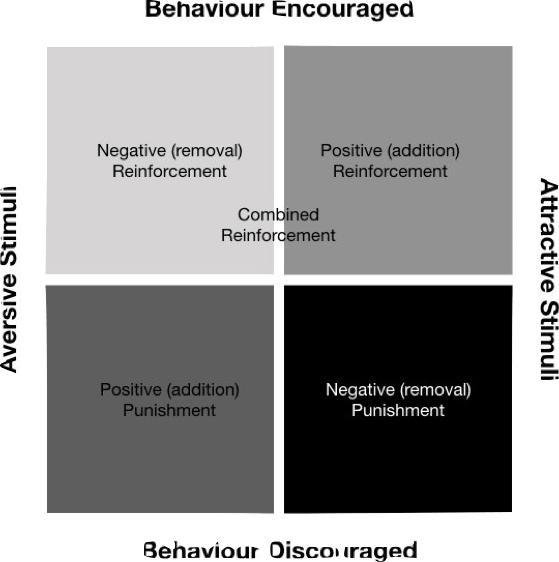
You can remember the term ‘operant conditioning’ by remembering that something is ‘operated’ on the horse. Something is either added to the horse or taken away from the horse to influence behaviour.
Reinforcement makes a behaviour more likely in the future.
Punishment makes a behaviour less likely in the future.
Operant conditioning is best explained with a picture. Things the horse doesn’t like are on the left, called Aversive Stimuli. Things the horse likes are on the right, called Attractive Stimuli. Both aversive and attractive stimuli can encourage behaviour (see the top quadrants) or discourage behaviour (in the bottom quadrants).
Horses learn best through reinforcement, and punishment is best avoided.
Reinforcement can be negative in the mathematical sense of the word, where something the horse doesn’t like is removed or subtracted in order to make a behaviour more likely in future.
Reinforcement can be positive in the mathematical sense of the word, where something the horse does like is added in order to make a behaviour more likely in future.
Combining both types of reinforcement together is highly effective and is called combined reinforcement.
7: CORRECT USE OF CLASSICAL CONDITIONING
Principle 7 is classical conditioning, which was made famous by Pavlov’s experiment. He trained dogs to salivate when he rang a bell by consistently ringing the bell before feeding the dogs. Soon, the bell predicted the food, and the dogs got ready by salivating.
When the phone rings and you answer it, or you hear a car door outside and know dad is home, or the smoke detector goes off and you get out of the house, you are responding to classically conditioned cues. The cue itself could mean anything. A phone ringing is a neutral sound, as is a car door, or the loud beeps of a smoke detector. We know what those sounds mean based on what happens immediately after them. The phone rings, and a relative is calling. The car door closes and a moment later dad walks into the house. The smoke detector goes off and then you see fire. We are trained to understand the sound by the sequence of events that follows.
Horses are incredibly good at learning sequences of events. The rider walks into the tack room after tying the horse up and he starts to paw, predicting that the rider is about to come back out with a bucket of food because that is what has happened hundreds of times before.
This trait in horses is very handy for teaching both vocal cues and incredibly light pressure cues. The lighter the cues can be, the happier the horse and the funner the ride.
When handling a horse, always use light pressure first and escalate, rather than starting with a firm pressure.
Classical conditioning is the most common culprit when a rider accidentally trains their horse to do something. Walking away from the mounting block is a common example. The sequence of events is, the rider gets on and then tells the horse to go. Pretty soon the horse is going as soon as the rider puts his foot in the stirrup. Understanding how to use classical conditioning prevents misunderstandings like this.
8: Correct Use of Shaping
Principle 8 shows how horses progress from basic training to advanced training.
Shaping is what transforms a behaviour from a basic movement to the most complex and physically challenging behaviours that people can train horses to do. Using the shaping scale developed by Equitation Science International gives a roadmap for how to develop a behaviour from first try to final, reliable result.
Picturing in your mind what your end goal for a behaviour is, and then planning out small, incremental steps to get there is an effective training strategy.
Start with only expecting the horse to try something that resembles what you want in the end. It will be far from perfect, but you will still reinforce the behaviour.
The horse quickly moves to obedience level, where the behaviour is given immediately to a light cue.
Then the trainer requires the horse to maintain the behaviour a bit longer to receive reinforcement, establishing a rhythm.
Then the behaviour must be maintained on the path you chose in order to be reinforced; this is straightness. At contact level, the horse can be trained to maintain a particular posture while performing the behaviour. Lastly, all the previous criteria for the behaviour can be trained to occur in any place, which is the proof that the training is complete.
9: CORRECT USE OF SIGNALS/CUES
Principle 9 explains how horses perceive signals.
Many things can be used to cue a horse: voice, posture, facial expression, body language, reins, hands, legs, sounds, whips, spurs, and more. Anything used as a cue must be used as a signal, not as a punisher. Remember, horses do not learn well from punishment.
Each signal for a different behaviour must be unique so the horse can distinguish what behaviour is being cued. Each signal may only mean one thing. That may seem obvious, but many riders will use their lower leg to tell their horse to speed up, and also use their lower leg to cue a turn. It is a good idea to take inventory of what cues you use with your horse and ensure they are not confusing.
Two signals must never be applied at the exact same time. Horses can only process one thing at a time. Asking for two things will mean that one of them gets overshadowed, like we learned in Principle 5. Many instructors teach to half halt by using simultaneous rein and leg pressures. This will desensitize the horse to one or both cues. It is much better to apply one cue and achieve a response and a moment later apply the next cue. With shaping, cues can safely be paired very close together.
The best riders are well versed in biomechanics and can time their cues to the most appropriate time in the horse’s stride so the correct behaviour is easy for the horse to give.
10: REGARD FOR SELF-CARRIAGE
Principle 10 applies to all the other principles, which is why it is last. At every stage in training, the handler should make sure that the horse is responding on its own. That is, the trainer is not forcing the behaviour, or physically maintaining the behaviour for the horse. When a horse is in self-carriage, or maintaining the correct speed, direction, posture, and whatever else is being trained, the horse can be relaxed.
Riders who ‘nag’ produce horses that are dull or begin to shut down.
Riders who prioritize self-carriage produce horses that are relaxed, willing, and responsive. Both horse and rider benefit!
CONCLUSION
Understanding these principles gives you an understanding of how your horse works on the inside, allowing you to communicate in a way that makes sense to him. Which principle gave you the biggest a-ha moment?


Thank you. I will keep this information. Marjorie
>
LikeLike
Hi Marjorie! Too bad you can’t subscribe for the videos, but I publish one video every Monday so if you like them you can check on Tuesdays and a new one will for sure be there!
LikeLike
Hi Claire. This came into my mail app today and I discovered you have a lot of things on You Tube. I listened to 3 of your excellent presentations.
I can’t comment or subscribe on anything on You Tube. To do that I would have to see your brother again. Last summer I bought a new computer and somehow I had to use the google mail app. Visits and phone calls to various people like Apple and Telus didn’t work until a woman at Mac fixed it. I think she somehow took away any access to google because I can’t use their maps or comment or like/dislike or subscribe on Youtube content.
I hope you are feeling much better and are getting to visit and/or ride your horses.
Hugs, Marjorie
>
LikeLiked by 1 person