6 Principles Good Horse Trainers Understand

Watch and listen to this in video form on the Clairety Horsemanship Video Lesson channel!

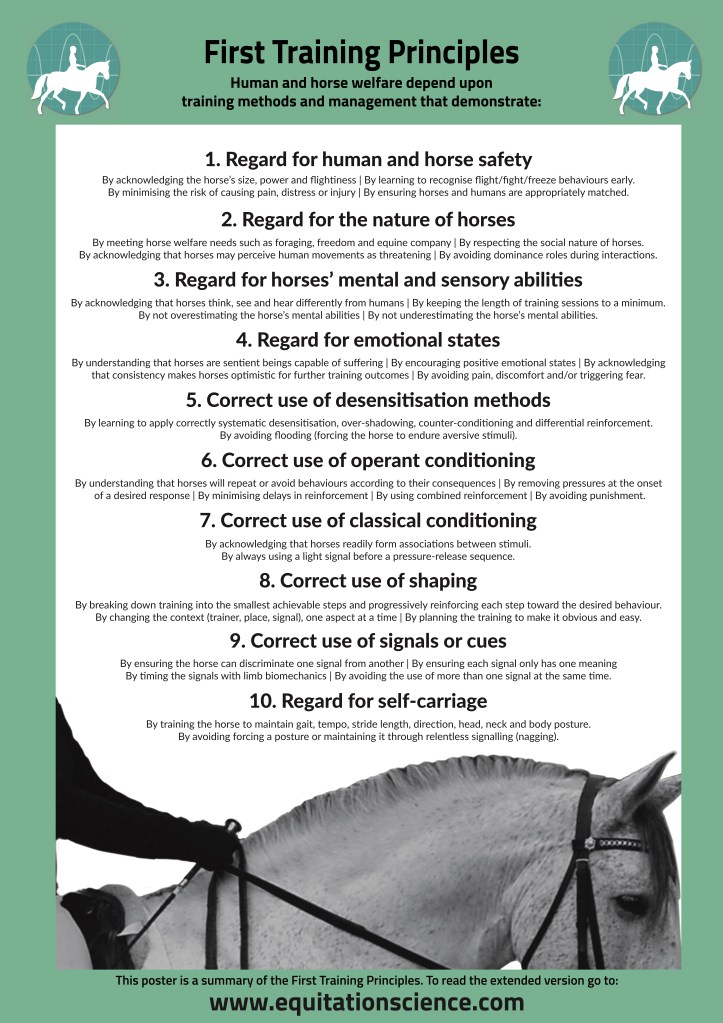
We will be exploring the ‘first principles’ of equitation science that relate to how horses learn, principles 5-10.

Remember, first principles are the assumptions or concepts behind a scientific theory. Equitation science is based on a few different scientific theories, so we have a few first principles to look at. Understanding these gives you the theoretical base to understand everything else I talk about!

The principles we are talking about today do not make up a horse training method. It is not copy-written like so many of the popular trainers’ methods today. These principles simply explain why and how horse training methods work (or don’t) so we can choose the most effective and ethical way to train a particular horse to do a particular behaviour.

Let’s get into the last six ‘first principles’.

5: CORRECT USE OF HABITUATION/DESENSITIZATION/CALMING TECHNIQUES

Principle 5 is about teaching a horse not to react to things. There are five habituation and desensitization techniques, four of which can be used ethically.

Systematic desensitization is what happens when a horse lives next to a highway and gets used to heavy traffic. At first it may run away from the road when load vehicles drive by, but soon it stops reacting to vehicle noise. This method is effective for most environmental applications, but because flight behaviour can be involved, a horse that is systematically desensitized may spontaneously recover fearful behaviour, given the right situation. When managed carefully in a training setting, the fear threshold can be avoided.

Overshadowing distracts the horse from the fear-inducing stimulus by using a previously trained response. Horses can only focus on one thing at a time, so cuing and repeating a simple response in the presence of an aversive stimulus allows the horse’s brain to accept the aversive stimulus as non-threatening. The stimulus is then moved closer and the process repeated.

Counter conditioning takes an event or object that the horse perceived negatively and associates something positive with it. Food is often used in this technique.

Differential reinforcement is a highly useful technique that helps riders avoid punishment. The trainer simply ignores behaviour that is not wanted, while rewarding preferred behaviour. This works extremely well for any behaviour that is not directly dangerous to the handler.

Flooding is the fifth habituation technique, and it should be avoided. Flooding occurs when a horse is completely helpless to escape the aversive stimulus. The horse will eventually give up, and the trainer thinks he has achieved what he wants. The horse, however, has an incredible fear memory and is likely to have an extreme reaction to that stimulus in the future unless it is restrained again. The other possibility is that the horse will enter the spectrum of learned helplessness. Neither outcome is a good or helpful one.

6: CORRECT USE OF OPERANT CONDITIONING

Principle 6 is about operant conditioning.

You can remember the term ‘operant conditioning’ by remembering that something is ‘operated’ on the horse. Something is either added to the horse or taken away from the horse to influence behaviour.

Reinforcement makes a behaviour more likely in the future.

Punishment makes a behaviour less likely in the future.

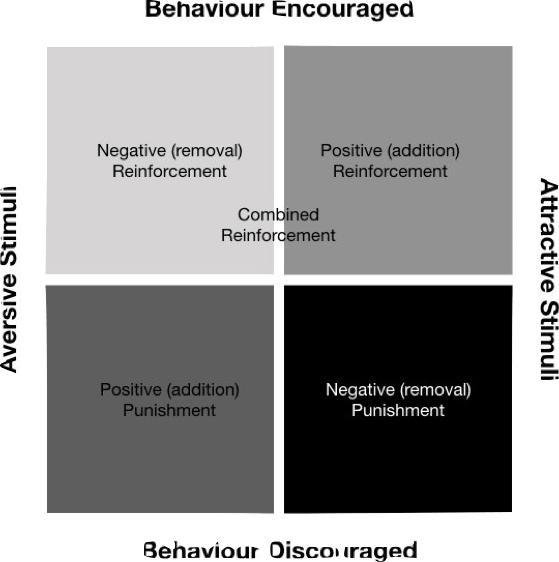
Operant conditioning is best explained with a picture. Things the horse doesn’t like are on the left, called Aversive Stimuli. Things the horse likes are on the right, called Attractive Stimuli. Both aversive and attractive stimuli can encourage behaviour (see the top quadrants) or discourage behaviour (in the bottom quadrants).

Horses learn best through reinforcement, and punishment is best avoided.

Reinforcement can be negative in the mathematical sense of the word, where something the horse doesn’t like is removed or subtracted in order to make a behaviour more likely in future.

Reinforcement can be positive in the mathematical sense of the word, where something the horse does like is added in order to make a behaviour more likely in future.

Combining both types of reinforcement together is highly effective and is called combined reinforcement.
7: CORRECT USE OF CLASSICAL CONDITIONING

Principle 7 is classical conditioning, which was made famous by Pavlov’s experiment. He trained dogs to salivate when he rang a bell by consistently ringing the bell before feeding the dogs. Soon, the bell predicted the food, and the dogs got ready by salivating.

When the phone rings and you answer it, or you hear a car door outside and know dad is home, or the smoke detector goes off and you get out of the house, you are responding to classically conditioned cues. The cue itself could mean anything. A phone ringing is a neutral sound, as is a car door, or the loud beeps of a smoke detector. We know what those sounds mean based on what happens immediately after them. The phone rings, and a relative is calling. The car door closes and a moment later dad walks into the house. The smoke detector goes off and then you see fire. We are trained to understand the sound by the sequence of events that follows.

Horses are incredibly good at learning sequences of events. The rider walks into the tack room after tying the horse up and he starts to paw, predicting that the rider is about to come back out with a bucket of food because that is what has happened hundreds of times before.

This trait in horses is very handy for teaching both vocal cues and incredibly light pressure cues. The lighter the cues can be, the happier the horse and the funner the ride.

When handling a horse, always use light pressure first and escalate, rather than starting with a firm pressure.

Classical conditioning is the most common culprit when a rider accidentally trains their horse to do something. Walking away from the mounting block is a common example. The sequence of events is, the rider gets on and then tells the horse to go. Pretty soon the horse is going as soon as the rider puts his foot in the stirrup. Understanding how to use classical conditioning prevents misunderstandings like this.

8: Correct Use of Shaping

Principle 8 shows how horses progress from basic training to advanced training.

Shaping is what transforms a behaviour from a basic movement to the most complex and physically challenging behaviours that people can train horses to do. Using the shaping scale developed by Equitation Science International gives a roadmap for how to develop a behaviour from first try to final, reliable result.

Picturing in your mind what your end goal for a behaviour is, and then planning out small, incremental steps to get there is an effective training strategy.

Start with only expecting the horse to try something that resembles what you want in the end. It will be far from perfect, but you will still reinforce the behaviour.

The horse quickly moves to obedience level, where the behaviour is given immediately to a light cue.

Then the trainer requires the horse to maintain the behaviour a bit longer to receive reinforcement, establishing a rhythm.

Then the behaviour must be maintained on the path you chose in order to be reinforced; this is straightness. At contact level, the horse can be trained to maintain a particular posture while performing the behaviour. Lastly, all the previous criteria for the behaviour can be trained to occur in any place, which is the proof that the training is complete.

9: CORRECT USE OF SIGNALS/CUES

Principle 9 explains how horses perceive signals.

Many things can be used to cue a horse: voice, posture, facial expression, body language, reins, hands, legs, sounds, whips, spurs, and more. Anything used as a cue must be used as a signal, not as a punisher. Remember, horses do not learn well from punishment.

Each signal for a different behaviour must be unique so the horse can distinguish what behaviour is being cued. Each signal may only mean one thing. That may seem obvious, but many riders will use their lower leg to tell their horse to speed up, and also use their lower leg to cue a turn. It is a good idea to take inventory of what cues you use with your horse and ensure they are not confusing.

Two signals must never be applied at the exact same time. Horses can only process one thing at a time. Asking for two things will mean that one of them gets overshadowed, like we learned in Principle 5. Many instructors teach to half halt by using simultaneous rein and leg pressures. This will desensitize the horse to one or both cues. It is much better to apply one cue and achieve a response and a moment later apply the next cue. With shaping, cues can safely be paired very close together.

The best riders are well versed in biomechanics and can time their cues to the most appropriate time in the horse’s stride so the correct behaviour is easy for the horse to give.

10: REGARD FOR SELF-CARRIAGE

Principle 10 applies to all the other principles, which is why it is last. At every stage in training, the handler should make sure that the horse is responding on its own. That is, the trainer is not forcing the behaviour, or physically maintaining the behaviour for the horse. When a horse is in self-carriage, or maintaining the correct speed, direction, posture, and whatever else is being trained, the horse can be relaxed.

Riders who ‘nag’ produce horses that are dull or begin to shut down.

Riders who prioritize self-carriage produce horses that are relaxed, willing, and responsive. Both horse and rider benefit!

CONCLUSION

Understanding these principles gives you an understanding of how your horse works on the inside, allowing you to communicate in a way that makes sense to him. Which principle gave you the biggest a-ha moment?

Can We Be Horses?

Many natural horsemanship training methodologies suggest the handler interacts with the horse as if he were, himself, a horse. This is typically said to involve body language, trying to mimic how the ‘alpha mare’ would interact with an insubordinate horse.

Recent research looks at the equine ethogram (a list of defined behaviours that horses display) to determine if it is possible for humans to interact with horses as other horses would, and if horses interact with humans as they would with horses. This article is based on the 2009 review article by McGreevy, Oddie, Burton, and McLean: The horse–human dyad: Can we align horse training and handling activities with the equid social ethogram? Published by The Veterinary Journal v 181, pp 12-18.

Similarities

At first glance, it seems that many of the behaviours horses display towards each other in their social groups are also displayed towards humans and vice versa. Humans approach horses and touch them, with scratching around the withers being more relevant than patting or slapping. Humans move horses around with chasing pressure, and horses have been known to chase a human. Mutual grooming can be undertaken between a horse and a human. We push horses over in the tie stall, and horses sometimes push us. Leading a horse with no rein pressure looks similar to horses trekking together (traveling single file). Young horses can display snapping to humans. The list goes on, but the closer we get to the barn, the fewer the similarities become. By the time we are picking the horse’s feet and saddling up, the similarities are quickly vanishing.

Limitations

The most well known natural horsemanship training technique, round penning, is an excellent example of the limitations of trying to behave like a horse, and of interpreting the horse’s responses as if they were responding to another horse. Studies have shown that the behaviours typically understood to demonstrate ‘respect’ in the round pen (licking lips, head lowering, approaching the human) are context-specific. That means they are only shown towards the human in the round pen training setting, not during other interactions. Studies have also demonstrated that the effects of round penning may be achieved with a remote-controlled car instead of a human, showing that negative reinforcement and not respect may be at the root of round pen behaviour. (Remember, negative reinforcement doesn’t mean bad, it means something–like pressure–is taken away to reinforce behaviour.)

Thinking about horse behaviour as if we are horses can also lead to us expecting the horse to know what we want, and describing them in terms of ‘willingness to please’. Both of these are dangerous ways of thinking, as they ascribe more mental capacity to the horse than it actually has, and the implications of these two assumptions lie in their opposites: if the horse doesn’t do as we wanted right away, we assume he is being wilfully naughty, doesn’t respect us, and perhaps even wants to spite us. These assumptions can lead to punitive training methods, lowering training uptake and reducing welfare.

Conclusion

Similarities exist between horse-horse interactions and human-horse interactions, but these become disjointed the closer the human gets to riding, and fall apart completely when the horse is mounted to be ridden. If the foundation of the horse’s training on the ground relies on attempting to be a herd member, there will be no training to rely on once the trainer wants to get on, as the horse cannot possibly see a rider as being a member of its herd—there are no longer any social analogues.

Basing training on learning theory, while still taking into account the horse’s behaviour, and learning to interpret behavioural signals accurately instead of trying to interpret them as a horse, seems to be a more logical and effective training strategy.

Do you want to learn how to interpret your horse’s behaviour more accurately to forward your training efforts? I’m launching a six week online course in January 2023 to teach just that. Submit the RSVP below to be first to know when registration opens in December.

← Back

Thank you for your response. ✨

Do you want to be first to know when the horse language course opens?(required)

Does Soft-talking Improve Training Outcomes?

Horse people talk to their horses. We praise them, cajole them, complain to them, tell them our cares and worries, and sometimes even shout at them. Many of us believe our tone of voice, if not the words, affect our horse’s behaviour. Heleski et al conducted a study in 2014 to find out to what extent soothing voice cues versus harsh ones assist in training.

Their hypothesis was that a soothing cue as the horse progressed through a potentially frightening task would improve the speed with which the horse was able to complete it calmly, while a harsh cue provided as the horse progressed would slow down the learning process and increase arousal.

Over 100 horses from different stables through Europe and the United States had five trials to cross a tarpaulin spread on the ground. The horses were randomly assigned to harsh voice treatment (quit it!) and soothing voice treatment (good horse). The handler led the horse towards the tarp using pressure and release on the halter, adding the vocal cue appropriate to the horse’s random assignment for each correct step towards the tarp. If the first crossing attempt took longer than ten minutes, the horse was considered to have failed. The goal was for horses to cross calmly within five trials. The time taken to cross each time, the horse’s heart rate, and its general behaviour were observed and recorded.

Interestingly, their findings were opposite to their hypotheses. There was no significant difference between harsh voice and soothing voice treatment groups in the percentage of horses that failed the learning task, in the groups’ average heart rates, or in the total time each group required to cross calmly. The maximum heart rate of the soothing voice group was actually higher than that of the harsh voice group.

There were no significant correlations with the horses’ ages when taken as an average. However, when 3-4 year old horses were compared with those 20 years or more, the older ones had much less latency to cross.

In the end, the harsh voice treatment group actually completed the learning task significantly faster than the soothing voice group. The researchers hypothesized that these unexpected results may show that tone of voice is either not distinguishable to the horse, or is not as salient to the horse as pressure cues, and may have ended up being perceived as ‘background noise’. They also suggested that handlers who were more familiar to the horses might have produced different results.

This suggests that while a soothing voice is likely not inherently calming to a horse in a novel situation, yelling at a horse for unwanted behaviour is equally ineffective. It is, however, theoretically possible with classical conditioning to teach a horse the difference between soothing voice and harsh voice. A soothing voice may additionally help the handler to remain calm, and correlations between horse and handler heart rates have been previously shown.

So, keep talking to your horse. Just realize that he is not taking in everything you are saying, and how you are saying it. Instead, make sure your training is clear so you get the responses you want.

Heleski, C; Wickens, C; Minero, M; Dalla Costa, E; Wu, C; Czeszak, E; and Köenig von Borstel, U. (2015) Do soothing vocal cues enhance horses’ ability to learn a frightening task? Journal of Veterinary Behaviour, 10(1):41-47.

The Horse that Couldn’t Lunge

I put together a before and after video of a young horse who had trouble learning to be lunged. Normally when a horse understands the basic go, stop, and turn commands, lunging is easy right from the first time. Not for Violet… she needed a creative solution that the principles of equitation science suggested. Watch the video to see the transformation!

(Facebook didn’t like the music I used in the video, but I do have the right to it!)

How to Turn a Horse

Often when a new client brings me a horse of theirs for a training lesson I ask a few simple questions to make sure all three of us (them, their horse, and I) are all on the same page. Their responses are interesting and surprisingly consistent:

Me: How do you tell your horse to go?

Client: I speed up my seat and then squeeze my legs.

Me: How do you tell your horse to stop?

Client: I slow down my seat and then squeeze the reins.

Me: [So far so good…] And how do you tell your horse to turn?

Client: First I half halt with my reins and legs at the same time, then I turn my head and put my inside hip forward, with my inside leg at the girth and my outside leg back. Then my outside hip pushes forward and around, my inside rein opens, and my outside rein pushes while both legs squeeze alternately and I close my left eye and wiggle my right big toe.

Right. That was confusing. Do you think perhaps the horse is confused too?

Having different cues for different responses that are clearly separated from one another is incredibly important for our horses’ mental well-being. If pressure from the rider’s lower leg sometimes means ‘go’ and sometimes means ‘turn’ in a slightly different combination, it is easy to get a confused horse, and confused horses generally cope in one of two ways: they shut down and stop responding, or they overreact and develop unwanted behaviour.

This isn’t to say that cues can’t become more complicated and closer together as horse and rider both progress. The most physically complicated movement in dressage is the pirouette, a turn on the spot at either walk or canter, which combines three basic responses in the space of three steps—less than one stride! Even then, the cues do not come at the same time. The rider cues for each response one at a time to build it into the pirouette.

What does it take to get to that point?

For both training the horse and training a riding student, I start at the very beginning with the simplest cues, which are pressure-based. In a new or frightening situation, the pressure-based cues are what the horse can fall back on and respond to reliably. I always start, then, with leg pressure for go, rein pressure for stop, and a single rein to the side for turn.

If horse and rider were to stay at this stage, that would be alright, though a bit rustic. But neither would improve, and it is better for the horse to reduce pressure cues. When the basic pressure cues are understood and are becoming reliable, I start to introduce seat cues. These are the rider’s movement patterns in the saddle that the horse can feel and respond to before receiving pressure from the bit or legs. A rider may speed up the movement of the seat for ‘go’, slow it down for ‘stop’, or turn the torso for ‘turn’. The horse quickly learns to feel the weight shift and predict what pressure will come next, allowing him to act first and avoid the pressure. This learning process is called classical conditioning.

Classically conditioned cues like seat or voice cues are less reliable than pressure cues in a new or scary situation. That is why I do not begin with classical cues. I prefer to have a solid foundation for horse and rider that I can build on to create beautiful movement and mutual understanding.

Trust? Or Safety?

Safety is very important to horses. While the most common horse training methods employ food or the release of pressure as a reward, it has recently been argued that safety is valuable enough to horses to be used by trainers as a resource during training to reduce fearfulness and increase learning uptake.

The goal of horse training is to reduce the expression of behaviour we don’t want and to draw out behaviour we do want, so that it is eventually offered on cue. Many behaviours that horses offer that we don’t like stem from fear. When a behaviour originating from fear is punished to make it less likely to occur again, negative emotions are likely to result, reducing effectiveness of training. Therefore, it is critical to understand fear responses in order to make better training decisions.

Fear responses are highly selected for because they promote survival. Fear is a kind of stress, and affects the animal’s behaviour in ways designed to make it easier to escape the situation. When fear is excessive or chronic, however, the physical cost of responding to the fear can affect health and behaviour. Animals may also react fearfully to things that do not pose an actual risk.

When a horse successfully escapes a fear-inducing stimulus (be that a plastic bag, a bush, or a rider), the behaviour that succeeded can be learned in a single trial, has the effect of reducing fear caused by the stimulus, and is resistant to being untrained. This suggests that the reduction in fear associated with performing an escape behaviour is highly reinforcing. Escape behaviour is in contrast to avoidance behaviour, where the animal receives warning about a fear-inducing stimulus and has the opportunity to avoid the stimulus by performing a behaviour.

In laboratory avoidance learning tests, when a ‘safety signal’ or neutral stimulus such as a light or a sound occurred when the animal had successfully avoided the fear-inducing stimulus, the test animals learned the avoidance behaviour much faster. The safety signal by itself reduced fear and held positive reinforcing properties. Once a stimulus becomes a safety signal, it rarely loses its meaning!

Other horses are probably the most common example of equine safety signals. Calm horses have the best effect, and silhouettes of relaxed or grazing horses have been shown to be recognized and greeted by horses. ‘Home’ is also likely to be a safety signal.

Reducing fearfulness should be a goal of horse training. It is possible that humans could also become a safety signal, depending on the horse’s previous experience of its handler specifically and people in general. The safety signal concept could be a better definition of the elusive notion of ‘trust’ in horse-human relationships.

If the horse’s trainer, handler, or owner can be perceived by the horse as a source of safety through consistent and careful training, learning could be enhanced and the risk of injury to horse and handler caused by a fear response could be greatly reduced.

McGreevy, P; Henshall, C; Starling, M; McLean, A; Boakes, R. (2014) The Importance of Safety Signals in Animal Handling and Training. Journal of Veterinary Behaviour, 9:382-387.

What does your horse want?

Horses have preferences, which they appear motivated to communicate with us when given the opportunity. Some horses enjoy firm brushing while others prefer limited grooming, and handlers well-versed in their body language can often determine what a horse is enjoying or wanting more of but it is often difficult to tell for sure. Researchers recently trained horses to use symbols to communicate their preferences about being blanketed or not in a much less ambiguous way!

It took all 23 horses used in the trial less than 14 training days to grasp the concept of bumping one symbol with their nose to have their blanket removed, another to have a blanket put on, and a third to remain as they were. This rapid uptake speaks well of the chosen positive reinforcement conditioning scheme the researchers used, and perhaps also of the horses’ motivation to make a choice for their own thermal comfort.

The researchers reported that once the horses began to understand that they could communicate their wishes, many horses even attempted to get the trainer’s attention from the paddock on a testing day and immediately chose blanket off. On removing it, it was found that the horse had become sweaty under the blanket, making the reason for the choice obvious.

On warm days, with temperatures around 20ºC, horses consistently chose to have their blanket removed if they wore one, or chose no change if they did not. On days where the weather was cold (~9ºC), wet, and/or windy, all but two of the horses chose blanket on if they did not have one, or no change if they did. This indicates that horses’ preferences are individual, with some horses having a higher tolerance for cold temperatures than others, with blanketing preferences to match. This was expected by the researchers, and confirms what we see in our horses every day.

For the owner looking for a challenging training project, teaching your horse to discriminate between symbols related to his management could take some guesswork out of the many choices we have to make for our horses. But for those owners who may not have the expertise yet to accomplish this, simply paying attention to your horse’s behaviour during routine handling can give insight into his preferences. Encouraging this communication by honouring it will help your horse to express himself more freely, building your relationship and mutual understanding!

The article is open access and can be found with this reference:

Mejdell, C; Buvik, T; Jørgensen, G; Bøe, K. (2016) Horses can learn to use symbols to communicate their preferences. Applied Animal Behaviour Science, 184 pp 66-73. https://doi.org/10.1016/j.applanim.2016.07.014

Talking to your Horse

Horse people talk to their horses. We praise them, cajole them, complain to them, tell them our cares and worries, and sometimes even shout at them. Many of us believe our tone of voice, if not our words, affect our horses’ behaviour. Heleski et al conducted a study in 2015 to find out to what extent soothing voice cues versus harsh ones affect training.

How the Study was Conducted

Their hypothesis was that a soothing cue as the horse progressed through a potentially frightening task would improve the speed with which the horse was able to complete it calmly, while a harsh cue provided as the horse progressed would slow down the learning process and increase arousal.

Over 100 horses from different stables through Europe and the United States had five trials to cross a tarpaulin spread on the ground. The horses were randomly assigned to harsh voice treatment (quit it!) and soothing voice treatment (good horse). The handler led the horse towards the tarp using pressure and release on the halter, adding the appropriate vocal cue for each correct step towards the tarp. If the first crossing attempt took longer than ten minutes, the horse was considered to have failed. The goal was for horses to cross calmly within five trials. The time taken to cross each time, the horse’s heart rate, and its general behaviour were observed and recorded. 

Results

Interestingly, their findings were exactly opposite to their hypotheses. There was no significant difference between harsh voice and soothing voice treatment groups in the percentage of horses that failed the learning task, in the groups’ average heart rates, or in the total time each group required to cross calmly. The maximum heart rate of the soothing voice group was actually higher than that of the harsh voice group.

There were no significant correlations with the horses’ ages when taken as an average. However, when 3-4 year old horses were compared with those 20 years or more, the older ones had much less latency to cross.

In the end, the harsh voice treatment group actually completed the learning task faster than the soothing voice group. The researchers hypothesized that these unexpected results may show that tone of voice is either not distinguishable to the horse, or is not as salient to the horse as pressure cues, and may have ended up being perceived as ‘background noise’. They also suggested that handlers who were more familiar to the horses might have produced different results.

Conclusion

This shows that while a soothing voice is likely not inherently calming to a horse in a novel situation, yelling at a horse for unwanted behaviour is equally ineffective. It is, however, theoretically possible with classical conditioning to teach a horse the difference between soothing voice and harsh voice. A soothing voice may additionally help the handler to remain calm, and correlations between horse and handler heart rates have been previously shown.

So, keep talking to your horse. Just realize that he is not taking in everything you are saying, and how you are saying it. Instead, make sure your training is clear so you get the responses you want.

Reference

Heleski, C; Wickens, C; Minero, M; Dalla Costa, E; Wu, C; Czeszak, E; and Köenig von Borstel, U. (2015) Do soothing vocal cues enhance horses’ ability to learn a frightening task? Journal of Veterinary Behaviour, 10(1):41-47.

Bailey: Aggressive Therapy Horse

This 22 year old mare had been used as a therapeutic riding horse for 5 years. During therapy sessions, she would not obey cues provided by the rider, requiring her handler to intervene. Her teeth would be grinding for the entire session, and periodically she would try to bite her handler, often resulting in an aggressive response from the handler. While being prepared for a lesson she would show signs of restlessness and aggression to the point where the Association wasn’t sure they could keep using her.

Aggression is always an alert to something being unclear or confusing in the horse’s training. The therapeutic association was right in questioning their continued use of her (Principle 1), but finding the cause would have been better. Responding with aggression typically makes the behaviour worse (Principle 2).

Bailey tended to grind her teeth when cued to stop, showing confusion about what the cue meant (Principle 9). The stop response was retrained, starting at obedience because she would slow a little bit when pressure was applied (Principle 8). Care was taken that there was no pressure when she was not being asked for something. The teeth grinding suddenly diminished, and the biting stopped entirely.

Next she was taught to ‘park’, an extension of the stop response. This was used in the tacking area, and when she realized that all that was required was standing still and not moving she quickly relaxed and even appeared to enjoy being groomed, wiggling her ears and lips when being brushed on the neck (Principle 5).

With the tension and conflict gone, she quickly became a favourite among the volunteers, and was able to continue serving as a therapy horse.