It can be easy to feel like you’re just ‘going in circles’ in riding lessons. I put my 10+ years of riding instruction experience into a 6-level program, so you can hold your progress in your hands!
The new Equitation Science Riding Level Program is based on learning sciences and designed to help you see how far you have come in your learning journey, and what your next steps will be.
The Levels
The rider level gradations are based on the equine shaping scale developed by Dr Andrew McLean. Learning Theory applies to horses as well as to humans, and it makes sense to teach riders new skills in a similar order to the horse’s learning progression. The levels are designed to provide a logical order of skills to learn, not a learning time-frame. Here is a description of each level:
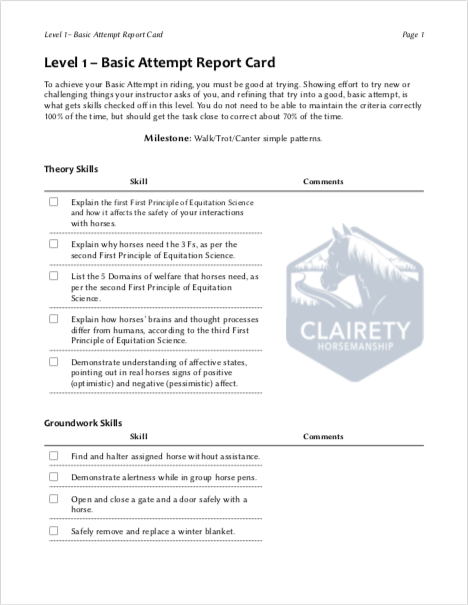
Level 1 – Basic Attempt
To achieve your Basic Attempt (BA) in riding, you must be good at trying. Showing effort to try new or challenging things your instructor asks of you, and refining that try into a good, basic attempt, is what gets skills checked off in this level. You do not need to be able to maintain the criteria correctly 100% of the time, but should get the task close to correct about 70% of the time.
Milestone: Walk/Trot/Canter simple patterns.
Level 2 – Obedience
To achieve the O level, you must become good at taking initiative and planning ahead on known tasks, and following direction competently in new tasks. Confidence and promptness in completing tasks is what gets skills checked off in this level, allowing you to navigate a pattern smoothly in a group of riders at all three gaits.
Milestone: Complete a course of poles on the ground and celebrate promotion to jumping (should you choose to follow that path).
Level 3 – Rhythm
To be a rhythmic rider, more precise control is acquired over your own body, and consequently over the horse’s body. The basic cues and tasks from the previous two levels are consolidated and happen automatically, leading to a soft leg and hand contact. This leaves you free to branch into poles and gymnastic jumping, if you so desire. Whether pursuing jumping in this level or not, you will begin to explore basic biomechanics, allowing you to affect stride length and speed, transitions, and the foundations of lateral movements. Fences in the jumping side of this level are cross-rail with a focus on rhythm and gymnastics.
Milestone: Competence with more sensitive horses through knowledge and application of learning theory.
Level 4 – Straightness
As a straight rider, you are learning to ride the horse to make a better horse. Having control over your body, you begin to feel when the horse is crooked or unresponsive and learn to use flexion, bend, and lateral movements to create strength and correct posture. If you opt to follow the jumping track, these skills translate to expanding jump types and increasing jump heights. Jumping students seeking further jumping skills are encouraged to branch out after this level. Both jumping and flat Straightness riders begin to understand horse behaviour more in-depth and apply their knowledge to horse-specific solutions.
Milestone: Ride a horse in balance, and train each horse you ride to be a little better! You are capable of resolving behaviour problems in an evidence-based way. You can skip to Level 6—Proof after successful completion of this level, if dressage is not your ‘thing’.
Level 5 – Contact
At Contact level you are focusing on the finer points of horsemanship, particularly the subtlety of biomechanical timing of cues with stirrup-stepping and other advanced techniques to begin achieving outline and collection across all previous criteria. Having a consistent or leased horse is recommended for this level. The focus shifts more toward dressage with movements coming together from basic responses.
Milestone: In addition to being able to retrain behaviour issues, you can now train new and complex behaviours!
Level 6 – Proof
As a rider in this level, you have all the skills and knowledge necessary to improve the training of a young or inexperienced horse. This level presents proof of your prior learning as you suit yourself to the horse’s current level, and bring it steadily along through the previous criteria to either Straightness level, or Contact level, depending on which one you have achieved. If you opt not to start a young horse, proof can be demonstrated by working a more seasoned horse through new situations or obstacles, taking the deteriorated responses at the level the horse presents and working confidently through the levels to return to Straightness or Contact.
Milestone: Young or inexperienced horse brought successfully along to a high level.
What’s Included
There are three packages to choose from, depending on your needs. There are no subscriptions or recurring payments—what you purchase is yours for life!
Student Package (starting at $15+GST+shipping):
- One level at a time in electronic format or all 6 levels together in a bound book
- Resource list for personal study
- Theory, Groundwork, and Ridden skills for each level
- Jumping, Flat, English, and Western options
- Dressage and Young Horse levels
- Includes certificates for successfully completed levels
Instructor Package (starting at $150+GST+shipping):
- Everything in the student package, plus:
- Roadmap showing expected student progression
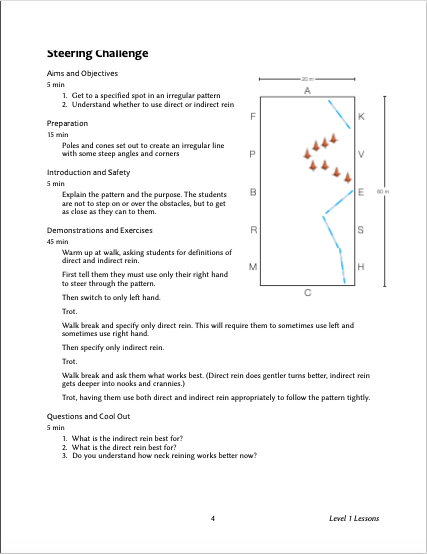
- 150 lesson plans and ideas with variations, divided by level, including groundwork lessons
- Test patterns for placing riders in the levels or evaluating completion of levels
Barn Package (starting at $320+GST+shipping):
- Discount on 10+ orders of the Student Package
- Everything in the Instructor Package (discount on extra Instructor Packages if your barn has multiple instructors)
- Summer Camp Curriculum (coming soon)
- Meeting Activities (coming soon)
How does it work?
Participants in the Program will turn in their Level Checklist to their instructor at the sixth or seventh lesson of each session (you’ll be reminded to bring it!), and will receive it back at the 8th lesson of each session with learned skills marked off and comments from the instructor. Once all skills in a level are complete, your instructor will sign your certificate, and you get to move on to the next level!
We recognize that learning is not linear. Students who have the book of all six levels may notice that their instructor marks off skills in a level above where the majority of their learning is taking place!
Do I need to complete 1 level per year?
No. The levels are not designed to be completed in a year, or in any specific time-frame. Instead, the levels group skills together that should be mastered in order for the student to understand the skills that come in the next level. Age, previous experience, and the time the student has to put into learning, all affect the speed at which a student progresses through the levels.
The levels are designed to help you learn at your own pace within a group or private lesson environment, providing feedback you can refer to about current learning goals and past goals accomplished.
There is a roadmap included in the level checklist book showing the average rider progression based on my 10+ years of instructing riders from very first lesson to competing in jumping and dressage. This roadmap should be taken as an encouragement to always continue learning.
Order Materials


Samples
Want to see a glimpse of the trove of information in the student and instructor packages? See one page from each copied below.