How to Get a Horse to Listen to You

You can watch and listen to this post on Clairety Horsemanship’s Video Theory Lesson channel!

Today we’re talking about the secret to making a horse listen to you, even if your feet won’t reach the stirrups. Hint: You don’t have to try to get big and strong. You can use this trick even if you’re little!

Can’t I ride a pony today? He’s closer to my size, it would be easier. I wish I’d grow faster! The horses won’t do anything for me, I need to get stronger.

I often hear this from little students. And I feel for you, I really do, but those solutions aren’t actually that helpful! Remember, I used to be the little kid with legs that seemed too short to do anything. But no one told me about this…

It’s not strength you need, it’s timing.

The Pin

Let me ask you a question. When you sit on a pin, why do you get off? Answer that poll for me quickly!

If you answered, because it hurts, you’re not alone. Most people answer that way at first. But think of it this way: the pain of sitting on that pin is actually only the motivator for you to try SOMETHING—anything—to make the pain stop! You might wiggle in your seat (oh that hurts more). You might squeal (that didn’t change a thing). And then you try getting up (ah, relief!) The pain isn’t what made you get off. It’s only because it STOPPED hurting when you got off that you knew that was the effective solution.

Horses work the same way. They learn by sequences.

Horses Learn From Sequences

Think of that pin from our last example. In the same way, pressure is one thing that motivates horses. Horses try to avoid pressure like water tries to avoid obstacles. Pressure can include physical pressure like our reins or legs or sounds, but also psychological pressure like uncertainty or confusion. What if the pain from the pin had went away when you screamed? Well that’s what you would do then right? Horses are the same. Whatever removes the pressure is what they will do again. So when you are squeezing and kicking and your horse isn’t going, it isn’t because you aren’t squeezing hard enough. It’s actually because you don’t STOP squeezing when you should! Maybe you stop too early, before the horse did what you asked. Or maybe you stop too late, long after the horse tried, and then gave up.

The secret to getting your horse to listen to you is learning your timing and getting it perfect.

You don’t have to be big and strong. All you need is perfect timing.

Do This to Get Your Horse to Listen to You

  • Start with please
  • Add motivation
  • Say THANK YOU
  • …every time.

To improve your timing, follow this sequence every time you ask your horse to do anything. ANYThiNG! From walking with you out of the field, to moving over in the tie stall, to turning a round circle in the arena, to jumping a 4’ oxer. Use this for everything.

Start with please. Use a light, but distinct, pressure cue. Only do as much as you want to have to do every time. If you start with a big kick, you’ll always have to start with a big kick, and no one likes that. Start with the smallest pressure you can that is still distinct so the horse can tell you are wanting something and not just wiggling.

Then, if the horse does not respond right away, add motivation. Motivation can be increasing pressure, but little legs can’t always do that. Increase what you can, but remember that being annoying is motivating too! Just keep at it and don’t give up.

Even though you are concentrating on adding motivation, pay careful close attention to what your horse is doing so you can say thank you at the right time. At first, just look for even a try in the right direction. Maybe your horse won’t move forward at all—you’ll say thank you to him for putting just one foot only one inch forward. To say thank you, immediately drop all pressure, and you can add a nice scratch in an itchy spot or a bit of food too.

Do this every single time you ask for anything. Little by little, your expectations can increase. With the case of that horse that won’t go forward at all, you’ll find after some repetitions of this that he’ll move his one foot one inch forward when you say please! Well done! You’re a horse trainer! Now you’ll increase your expectations and add motivation until you get two steps and immediately give a nice enthusiastic thank you. It won’t be long before you’re trotting all around that arena. Not because you kicked harder, but because you got your timing right.

Assignment

Here’s an assignment for you.

Practice the Listening Sequence. Cue a simple movement—don’t forget to say please! Start with something like backing up a step, or walking forward a step.

Add motivation. Don’t stop asking until he at least tries.

Say thank you! The moment he gives it a try, quit all your cueing and motivation, and add some reward.

Repeat at least three times. Even better, count how many times you need to follow the sequence before your horse responds to your ‘please’! Most horses learn to listen to ‘please’ in the first 7-10 repetitions. Then come back and let me know in the comments how long it took your horse to start listening to you when you said please—all because you started saying thank you!

These 4 Principles will Change how you see your Horse

Listen to this post as a video on YouTube! https://www.youtube.com/watch?v=k3CtB6Cz64Q

The first principles of equitation science is the best place to start when trying to understand your horse. What is a first principle? First principles are the assumptions or concepts behind a scientific theory. Equitation science is based on a few different scientific theories, so we have a few first principles to look at. Understanding these gives you the theoretical base to understand everything else we will talk about on this channel.

Today we will look at the first four ‘first principles’. These are what I call the ‘horse principles’ and they apply to any horse. The second set of ‘first principles’, that I call the ‘training principles’, deal more with the specifics of training. We will look at the those in the next post.

Equitation science is not a horse training or teaching method. It is not copy-written like so many of the popular trainers’ methods today. It seeks to define and study the parts of the relationship between people and horses that can be measured and defined. This includes learning theory, ethology, and biomechanics. Learning theory explains how horses’ brains process information to learn from it, enabling us to train them more effectively. Ethology describes each of the behaviours that horses exhibit, allowing us to understand what is normal and how to care for horses according to their needs. And biomechanics studies how horses move, allowing us to become better riders.

Some aspects of a relationship between horses and humans are difficult to scientifically define, like ‘feel’ and ‘trust’ and ‘respect’ which are words often used in the natural horsemanship methodologies. Some people don’t like that equitation science does not address these things, but they are simply not within the scope of what equitation science seeks to clarify. ‘Trust’ and ‘respect’ cannot be measured scientifically with any kind of empirical experiment, so equitation science does not speak to it. The goal of equitation science is rather to study what is measurable and definable so we can apply it to our daily interactions with horses and make the experience more positive for both us and the horse.

Let’s get into the first principles.

Principle 1: Regard for Human and Horse Safety

Knowing how something works is the first step to using it properly. Take a kitchen knife for instance. A knife can be dangerous if used improperly. If you don’t know which side is sharp, you are likely to cut yourself by accident instead of slicing your cheese. In the same way, if we study how horses work, and how they are different from us, we are less likely to run into dangerous situations.

We know that horses are flight animals. Their preferred reaction to fear is to run away. If they cannot run, they may freeze or fight. Recognizing when a horse is scared and being able to defuse the fear or deescalate the situation keeps you safer, and helps the horse to relax.

One of the biggest parts of planning my lessons is choosing which student gets to ride which horse. Matching rider ability and personality to horse training level and temperament is very important for safety. Ensuring the horses are tacked up correctly and the arena is clear of hazards is also part of my job.

Lastly, confusion worries horses. When a rider gives an ineffective cue, or conflicting cues, the horse becomes confused and this can build up into frustration and unwanted behaviours like aggression, ears back, biting, kicking, bucking, and many more. The goal of every rider and horse lover therefore should be to understand better how horses work from the inside out, giving the horse a sense of security, keeping both horse and rider safer.

Principle 2: Regard for the Nature of Horses

Because horses are horses, they have certain social and welfare needs that we need to do our best to meet.

They require companionship of other horses. They require the ability to forage for food, and to move around. They need to create herd structure (which is very far removed from the old concept of dominance and submission—more on that in another video). And they display pain in very subtle ways that we need to learn to understand.

Our nature is quite different from that of horses, which means they can easily perceive us as a threat. Learning how to move and interact around horses helps to bridge the gap between our two natures.

Principle 3: Regard for Horses’ Mental and Sensory Abilities

Horses are different from humans. They think differently. They have different instincts. They interact with one another differently than they interact with us. Treating a horse like a horse and not like another person is vitally important for their welfare.

When people start thinking that a horse is just another human, they start expecting more of the horse than it is capable of. They begin to expect the horse to read their mind, or to ‘know better’. They begin to attribute their own emotions to the horse, sometimes wrongly attributing unwanted behaviour caused by confusion or pain to the horse ‘being silly’ or ‘trying to annoy me’. The problem with thinking this way is that your reaction to a horse’s behaviour will be shaped by what you think caused it. If you think the horse is trying to annoy you, you might feel justified in punishing it with a slap. What if it was displaying pain-related behaviour? Then your slap could actually escalate the horse’s behaviour rather than put an end to it. If you think your horse should ‘know better’ than to paw at the ground, the onus is no longer on you to make sure that he understands your training. If the unwanted behaviour stems from incomplete training of the ‘stop’ response, then it is your training at fault, and not the horse. You can see how treating a horse like a human can lead to misunderstandings, which can be dangerous.

Treating the horse as less than a horse is equally dangerous. Horses are very intelligent. Assuming that ‘it’s just a dumb horse’ could lead the rider to harsher than necessary, which could cause the horse to begin to shut down, or learn to be helpless. The concept of dominance in horse training is very outdated and should not be used.

The best way to arrive at an accurate conclusion about a behaviour is to ask, ‘what happened?’ And describe the exact physical motions that occurred. For example, if there is a loud noise and your horse spooks, you could say, ‘my horse doesn’t like noises,’ which will leave you at a loss for a solution, as noises happen all the time. Instead, try, ‘there was a loud noise and my horse sped up three steps and turned left sharply two steps.’ Now the solution is obvious: the horse sped up and turned when you didn’t ask, so you simply slow down and turn back.

Principle 4: Regard for Current Emotional States

Understanding your horse’s level of arousal is very important in training. Think of arousal as a scale of 0-9. If your horse is asleep, his arousal level is 0. He’s not thinking about anything, and motivation to do anything is lacking. If it feels like you are flying your horse like a kite on the end of your lead rope, he’s at arousal level of 9. There is no way he can pay attention to you, and is unlikely to learn anything positive. Too much or too little arousal, and learning a task is very difficult. Recognizing where the horse is at the moment and being able to change your behaviour to bring your horse up or down the scale is an important training tool.

Based on their interactions with humans, horses begin to develop either a positive emotional state or a negative one. A positive state is like optimism, where a horse expects things to turn out well and is interested in interacting with humans. A negative state is like pessimism, where the horse expects the interaction to be confusing or unpleasant, and tries to avoid interacting with humans.

Every interaction a horse has is adding to his emotional file. The more positive outcomes the better. These facts can tempt some riders to be too ‘soft’ as they try to make the horse like them. Horses, however, find consistency and predictability to be positive, so when riders begin to ‘bend the rules’ and let the horse do unwanted things, the horse actually experiences negative emotions due to the inconsistency.

Being firm but fair is a good way to think about contributing to a horse’s positive emotional state.

Conclusion

Allowing these four principles to permeate how you think about and interact with your horse will change your relationship for the better!

What Equitation Science Can Do for You

If you’re a horse lover, chances are you’ve spent countless hours learning about these majestic creatures. But in your journey, you’ve probably encountered a fair share of conflicting advice—one expert swears by training with treats, while another says they’re a terrible idea. One trainer insists rope halters are the key to success, while another argues they’re too harsh. And then there’s the endless debate about bridles vs. bareback riding with a neck rope.

With so many differing opinions and techniques—from the practices of different disciplines to the personalities of passionate horse people—it’s easy to feel overwhelmed. And here’s the thing: if you’re confused about how to approach training, how can your horse possibly understand what you want from them?

This is where equitation science comes in. It’s not just a set of techniques or trends. Rather, equitation science is the study of how horses think, learn, and respond. It’s about using science to understand your horse’s behavior in measurable ways, breaking down the “why” and “how” behind every action, and offering insight into what works and what doesn’t.

Equitation science provides you with a bird’s-eye view of the horse-human relationship. Instead of getting bogged down in the specific methods of individual training styles, you can begin to see the broader patterns and principles that underlie effective, compassionate interaction with horses. It shows you the true science behind the techniques you already use—perhaps without fully understanding their impact—and helps you improve those techniques.

Unlike a particular training method or discipline, equitation science transcends them all. It’s universal, speaking to every rider and trainer, regardless of their background or approach. And in a world where the horse industry feels divided and under scrutiny, equitation science has the power to bring us together. It offers a shared understanding that can unite trainers, enthusiasts, and professionals across different styles and approaches.

Why is this so important? Because the horse world is currently facing significant challenges—from public perception to internal disagreements. Our practices and the way we communicate with horses are under the microscope, and we need a framework that allows us to address these concerns while fostering positive, sustainable change. Equitation science offers that clarity and unity. I’ve seen firsthand how a deeper understanding of equitation science has helped me improve my own interactions with horses, and I truly believe that when we know better, we do better.

Are you ready to take the next step in your journey with horses? Will you commit to exploring the measurable, scientifically-backed aspects of the horse-human relationship? Equitation science will not only provide clarity amid the confusion but also offer a path forward for positive change in the horse industry.

If you’re unsure where to start, I recommend reading this insightful article on applying equitation science practically (https://clairetyhorsemanship.ca/2022/02/02/can-horse-training-outcomes-be-predictable/). And if you’re looking to deepen your understanding, stay tuned for upcoming audio riding lessons based on equitation science, designed to complement your lessons with your coach (https://clairetyhorsemanship.ca/pocket-riding-coach/).

Take a moment today to explore these resources, and make the commitment to learning what equitation science can do for you—and for your horse.

Horse Emotions

Introduction and Definition of Terms

When a horse is worried about something, he doesn’t pay much attention to you. That’s when his ‘arousal’ level is high.

A horse can also be optimistic or pessimistic—he can expect a new experience to be positive or negative. That’s his ‘emotional state’.

His level of arousal and emotional state taken together are his ‘affective state’ and dictate the quality of work he is capable of and what kind of reinforcement will be most effective for training at that moment.

Being able to read a horse’s affective state and respond appropriately in the moment could make the difference between raising his arousal level further until he can no longer interact with you and making significant progress towards your goal, whether that goal is quality time with him or higher steps in piaffe.

How Arousal is Created

We don’t yet know exactly what levels of arousal are ideal for training new behaviours. However, common sense and practical experience agree that if the horse is not aroused enough (if he is asleep), or if he is too aroused (if he fears for his life), there will be little useful interaction between horse and human.

Determining what level of arousal will be best for the intended activity with a horse could greatly benefit the interaction. For a therapy session, a very relaxed horse with a low level of arousal is preferred. For resolving a behaviour problem, a higher level of arousal will be needed so the horse is motivated to trial new responses and find the correct one. For shaping a trained behaviour, medium arousal will be best, so the horse can think about what is being asked.

How Negative Affective States are Created

We know more about negative affective states than positive because animal welfare criteria used to be based on the absence of negatives rather than the presence of positives. Positive experiences were finally introduced in the 2020 Five Domains Model.

When a horse’s expectations of the outcome of certain behaviours or events are not met, the difference between expectations and actual outcome creates frustration. Frustration in any or all of the four physical domains (Nutrition, Physical Environment, Health, and Behavioural Interactions) will create a negative state in the fifth Mental domain. This negative state can contribute to aggressive behaviour and, if frustration continues, will create a long term negative outlook. The use of punishment in training can also contribute to a negative state.

How Positive Affective States are Created

Use of the principles of equitation science in training has been shown to help avoid negative affective states during training. For welfare, however, it is not enough to avoid the negative. Working actively to help create a positive experience for the horse will contribute to positive affect and relationship.

In a study by Freymond et al, horses trained with addition reinforcement (where something pleasant is given to the horse to reinforce correct behaviour) were found to have more positive emotional states than those trained with subtraction reinforcement (where something

unpleasant is taken away to reinforce correct behaviour). Interestingly though, after the training session the subtraction-reinforced horses experienced a more positive overall emotional state than the addition-reinforced horses had. This suggests that trainers and owners employing combined reinforcement (use of both addition and subtraction reinforcement) may be able to positively influence their horse’s mood.

Conclusion

Awareness of how a horse is currently feeling is a great asset to any horse person. This knowledge makes it easier to predict what the horse will do in any given situation, enhancing safety and even making it possible to change plans to create a positive experience for the horse.

Keeping the lowest level of arousal required for the activity is essential to good training, positive welfare, and good relationship. Not everything in the human-horse relationship is going to contribute to a positive emotional state (for example, horses are unlikely to ask for a vaccination!), but even the negatives can be countered in other ways to develop an overall positive affective state in a horse.

Bibliography

Creighton, E. (2007) Equine learning behaviour: limits of ability and ability limits of trainers. Behav. Process. 76, 43–44.

Freymond SB; Briefer EF; Zollinger A; Gindrat-von Allmen Y; Wyss C; and Bachmann I. (2014) Behaviour of horses in a judgment bias test associated with positive or negative reinforcement. Appl. Anim. Behav. Sci. 158, 34–45.

Mellor, DJ; Beausoleil, NJ; Littlewood, KE; McLean, AN; McGreevy, PD; Jones, B; and Wilkins, C. (2020) The 2020 Five Domains Model: Including Human-Animal Interactions in Assessments of Animal Welfare. Animals 10, 1870. Open access: https://www.mdpi.com/ 2076-2615/10/10/1870

Olczak, K., Nowicki, J., and Klocek, C. (2016) Motivation, stress, and learning–critical characteristics that influence the horses’ value and training method–a review. Ann. Anim. Sci. 16, 641–652.

Starling, MJ; Branson, N; Cody, D; and McGreevy, PD. (2013) Conceptualising the Impact of Arousal and Affective State on Training Outcomes of Operant Conditioning. Animals 3. Open access: https://www.mdpi.com/2076-2615/3/2/300/pdf

page2image49469824 page2image49470016 page2image49470976

Out in the Cold

Introduction

As the weather gets colder and we start to put on layers and stay inside, it is easy to assume that our horses would prefer to be inside a heated building, in the comfort of a deep bedded stall. Sometimes we keep horses inside for our own convenience—they can’t get dirty, don’t take as long to catch, or can cool down before being put outside—but sometimes it is done from the honest conviction that the horse would prefer it that way.

Many people know about the evidence to the contrary, that horses tend to develop abnormal behaviour when kept inside, such as cribbing, weaving, stall walking, and aggression. However, we’ve also heard that providing the horse with a toy or two and a hay net makes his life in the box stall a pampered one.

These are well-intentioned attempts to make the box nicer for the horse, but their effect is quite limited. Here are the facts about what these ‘enrichments’ actually do for the horse. I end with practical suggestions for housing that more closely suits the horse’s needs.

Welfare

We all want our horses to have a good life. That’s why we buy them treats and new brushes and fit their saddles and get blankets—and, all to often, bring them inside for the winter. Wanting them to have a good life is equivalent to wanting them to have good welfare. Welfare refers to quality of life—how easily a creature is able to adapt to its environment (Waran, 2002). If it is difficult or entirely impossible to completely adapt to the environment, the animal has poor welfare. If it can adapt and fit in, there is good welfare.

When horses show stereotypical behaviour (repetitive, abnormal behaviours like cribbing), aggression towards humans, behaviours caused by stress, or lack of engagement in the environment, these are attempts by the horse to cope with an environment that it doesn’t easily fit into. The presence of these four criteria can be used to assess welfare, and were used by Ruet et al (2019) in their study of housing horses in boxes.

It is easy to see how saddles illustrate this. A horse can never adapt its back to a poorly fitting saddle, and is likely to show aggression when it is put on and stress related behaviours when being ridden, so the saddle compromises its welfare. For a well-fitting saddle, however, the horse is adapted already, and its welfare is improved.

The same comparison may be made for any situation. Let’s see how it applies to box stalls.

Enriching the Box

The goal of enrichment is to make animals in an unnatural environment more likely to display the natural behaviours they would engage in in a natural environment. Bulens et al (2013) note that the most effective enrichment is providing something for the horse to eat, as 50-70% of their time is spent eating normally. In their study they used a bottle filled with sand and suspending from the ceiling, and a rope similarly suspended for the horse to play with. They found that the enriching effects of these objects were similar to other studies that looked at commercially available horse toys. Any beneficial effect was quite limited because they did not allow the horse to increase normal behaviour (locomotion, and interaction with other horses).

Ruet et al (2019) examined 12 factors in the lives of stabled horses: sex, age, time spent in the box, whether there was a window into the next stall, the bedding type, how much feed was given, how much concentrated feed was given, what discipline the horse was used in, the level of performance, the number of competitions, hours spent working per week, and lunging or walking time per week. Only three of these factors exhibited a positive change in the horse’s behaviour: straw bedding seemed to reduce aggression towards humans, a box with a window also reduced aggression, and less concentrated feed reduced repetitive abnormal behaviours, especially cribbing.

In short, enrichments weren’t as enriching as originally thought.

The Effect of Turn Out

Unresponsiveness to the environment, no longer showing interest in events or happenings around it, increases the more time the horse spends inside. This is shown by a withdrawn posture, where the head is level with the back, the ears do not move much, and the horse just does nothing (Ruet et al, 2019). While there is a place for horses to rest in a posture similar to this, this refers to an abnormal amount of time spent in this posture.

Horses that show stressed behaviours in the box, like pacing, calling out, or holding an alert posture for long periods are most likely to begin to slip into unresponsiveness, suggesting that these behaviours may be comparable to anxiety and depression (Ruet et al, 2019).

These behaviours are all reduced or non-existent when horses are studied at pasture with social interaction and space to move freely; to prevent this downward slide into poor welfare, avoid keeping a horse inside (Mills and Clarke, 2002).

Surviving Stall Rest

Horses that receive some turnout display the four indicators less often, showing an improvement in welfare, or at least a reduction in the deterioration of welfare caused by living inside (Ruet et al, 2019).

However, sometimes it is absolutely necessary to keep a horse confined inside, such as in stall rest. In this situation, using anything that may help the horse cope is advisable (Mills and Clarke, 2002). Allowing contact with another horse, providing a variety of food and a constant supply of fibre, keeping the lights on, and anything to keep the horse interested in the environment through sounds and sights can all help to reduce the negative welfare implications of forced stall rest.

We Live in Canada

What about when it is cold? The thermoneutral zone of horses, where there is no increased effort to maintain internal body temperature, is between -15 and 10 degrees Celsius in still air, and between 5 and 25 degrees Celsius under more normal environmental conditions (Morgan, 1998). Below 5 degrees the horse’s metabolism must increase to maintain internal temperature (Morgan, 1998). Providing continuous access to food to support the increase in metabolism along with adequate shelter is sufficient for the horse to maintain its internal temperature and body condition score over winter without compromising welfare (Mejdell and Bøe, 2005).

Conclusion

Horses were designed to live outside and express normal behaviour, to move freely in groups of other horses, to eat for most of the day, to avoid fear and distress, and to be able to avoid unpleasant or painful situations. While these ‘five freedoms’ have been criticized by some, they are still a good general guide (Mills and Clarke, 2002). The four factors used in Ruet et al’s (2019) study are also not all-encompassing and other factors and indicators should also be studied.

If your horse is quiet in the box, is he ‘good to stable’ or is he withdrawing from his environment?

If your horse chews any exposed wood, is he ‘trying to annoy you’ or expressing that his normal behaviours are being frustrated?

If your horse is vigilant and pacing in his box, is he ‘full of beans’ or on the road through anxiety to depression?

If your horse shows aggression towards you, is he being ‘naughty’ or coping with a suboptimal environment by letting the frustration out—towards you?

If you have the option, are you going to keep your horse inside and compromise his welfare, or let him be a horse as much as possible?

References

Bulens, A; Van Beirendonck, S; Van Thielen, J; and Driessen, B. (2013) The enriching effect of non-commercial items in stabled horses. Applied Animal Behaviour Science 143:46–51 

Mejdell, CM and Bøe, KE. (2005) Responses to climatic variables of horses housed outdoors under Nordic winter conditions. Can. J. Anim. Sci. 85: 307–308.

Mills, DS and Clarke, A. (2002) Housing, Management, and Welfare. In: The Welfare of Horses: Waran, N (editor) Springer: Dordrecht, The Netherlands.

Morgan, K. (1998) Thermoneutral Zone and Critical Temperatures of Horses. J. therm. Biol. 23:1 pp. 59-61

Ruet, A; Lemarchand, J; Parias, C; Mach, N; Moisan, M-P; Foury, A; Briant, C; and Lansade, L. (2019) Housing Horses in Individual Boxes Is a Challenge with Regard to Welfare. Animals 9:621

Waran, N. (2002) Preface. In: The Welfare of Horses: Waran, N (editor) Springer: Dordrecht, The Netherlands.

Are Horses Intelligent?

Before you say, ‘of course!’…

Intelligence

It is important to define words that can mean different things to different people. The word of interest here is ‘intelligence’. What is intelligence?

Jacques Lautrey (2004) has proposed this definition: “Intelligence is… the capacity of an organism—or of an artificial system—to modify itself to adapt its behaviour to the constraints of its environment… But this cognitive ability to adapt does not qualify as intelligence unless it is generalizable to a fairly high degree, that is, if it appears in different situations….”

Comparing Intelligence

While no scientist will agree with another on a definition, there seems to be a general consensus that every species is ‘intelligent’ in a certain way. There are many forms of intelligence. While the number and type of these forms is also debated, one scientist (Howard Gardner, 1985) proposed eight types, and observed that each species of animal had strengths and weaknesses in each of the eight types. Rats are spatially intelligent, for example, and birds are musically intelligent (Leblanc, 2013).

For this reason, comparing levels of intelligence between species (i.e. between horses and humans) is essentially meaningless. Comparing one horse’s strengths to another horse’s, or to the general horse population, is more meaningful than comparing a horse’s strengths with a human’s strengths to determine comparative intelligence (Leblanc, 2013).

Intelligence and Cognition

Now, the way we use the word ‘intelligence’ in everyday life really doesn’t make this matter any simpler. Depending on the context we use it in, it could mean many different things, from the ability to learn to possessing the power of reason. In scientific literature, ‘intelligence’ is typically used of behaviour that is begun by an innate response, such as an instinct, and allows the creature to make specific adaptations in response to specific problems (Vauclair, 1996). In contrast, they may use the word ‘cognition’ to describe the way an animal learns and processes information, allowing a creature to adapt to unpredictable changes in its environment. The distinction is subtle, but fairly important.

So, when an animal is able to adapt a response that it has learned already (as opposed to an instinctive response) to a new situation, and when the newly adapted response can itself be generalized to suit other new situations, the animal has cognitive ability (Leblanc, 2013).

Both intelligent responses and cognitive responses are observed in horses. When we speak of these mental abilities in relation to trained responses, however, cognition is the more accurate ability to measure.

A Helpful Way to Think about Intelligence

We may consider a horse to be intelligent if he learns a new concept easily (and by extension not intelligent if they do not learn quickly). However, training is influenced by at least eight massive variables: learning ability, the human’s knowledge and skill, the horse’s temperament, conformation, history, and health, and the training environment (McGreevy and McLean, 2010). It is more helpful, then, to think of controlling these variables rather than appealing to the horse’s intelligence.

Further, we may consider a horse to be intelligent if he seems able to read our minds. However, this is really a product of the eight variables above, where the horse has learned to recognize subtle cues. This is usually a result of the horse’s adeptness at making associations and generalizing (McGreevy and McLean, 2010).

Finally, a horse may be considered intelligent if he has learned behaviour that thwarts his handler’s wishes. This again, however, if a product of the eight influences on training, and is more an indication of how these factors have affected the horse’s environment than a reflection of the horse’s level of intelligence (McGreevy and McLean, 2010).

What this Means

In our interactions with horses, it is counter-productive to our goal (and our morale) to wonder if the horse is more or less intelligent than we are. What we should be most concerned about, in order to really understand our horses and relate to them better, is comprehending the horse’s cognition, which includes learning processes, mental capacity, and information processing (Leblanc, 2013). Understanding how these processes differ from ours will enable us to treat the horse as a horse—leading to improved welfare for the horse and greater success for us.

Conwy Lloyd Morgan (1894) proposed this principle, known as Morgan’s canon, which makes a great deal of sense even now: “in no case may we interpret an action as the outcome of a higher psychical faculty, if it can be interpreted as the outcome of the exercise of one that stands lower in the psychological scale”.

In other words, if your horse knocked you over with his nose, it is probably more accurate to say that he learned to push in order to receive food than that he is trying to get back at you for forgetting to bring treats.

References

Gardner, H. (1985) Frames of Mind: The Theory of Multiple Intelligences. New York: Basic Books.

Lautrey, J. (2004) Hauts potentiels et talents: La position actuelle du problème. Psychologie Française49:219-32

Leblanc, M. (2013) The Mind of the Horse. Cambridge, MA: Harvard University Press.

McGreevy, P and McLean, A. (2010) Equitation Science. West Sussex, UK: Wiley-Blackwell.

Morgan, CL (1894) Introduction to Comparative Psychology. London: Scott.

Vauclair, J. (1996) Animal Cognition: An Introduction to Modern Comparative Psychology. Cambridge, MA: Harvard University Press.


5 Horse Principles

There are 5 things best to keep in mind when dealing with any horse, especially one with behaviour problems:


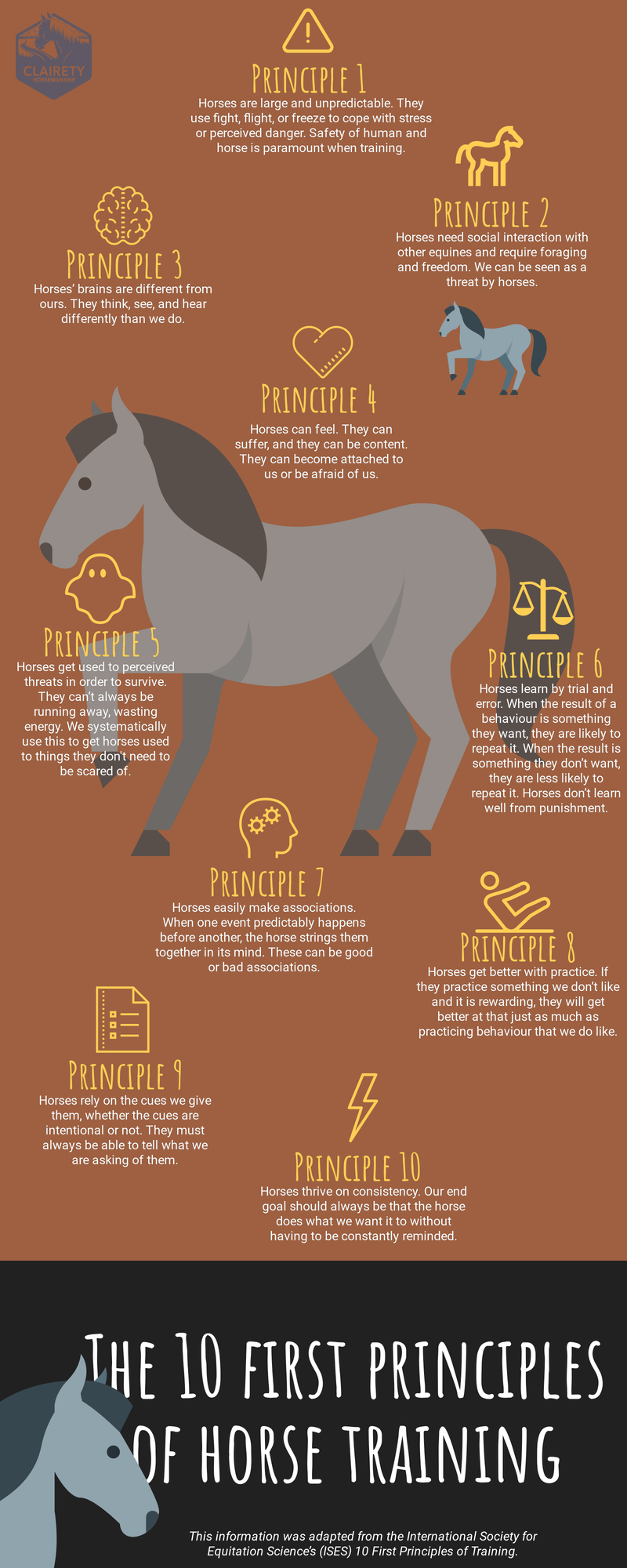
• Horses are large and unpredictable. They use fight, flight, or freeze to cope with stress or perceived danger. Safety of human and horse is paramount when training.


• Horses need social interaction with other equines and require foraging and freedom. We can be seen as a threat by horses.


• Horses’ brains are different from ours. They think, see, and hear differently than we do.


• Horses can feel. They can suffer, and they can be content. They can become attached to us or be afraid of us.


• Horses thrive on consistency. Our end goal should always be that the horse does what we want it to without having to be constantly reminded.


Want to know what each of these means for your relationship with your horse?

When you sign up for lessons, I teach these basic five things to keep in mind, as well as five training tools (see this post) so that you understand why you are doing what you do when you ride.

Or, sign your horse up for training and you can watch as many training sessions as you like as well as receive a lesson when you pick your horse up!

Register Now


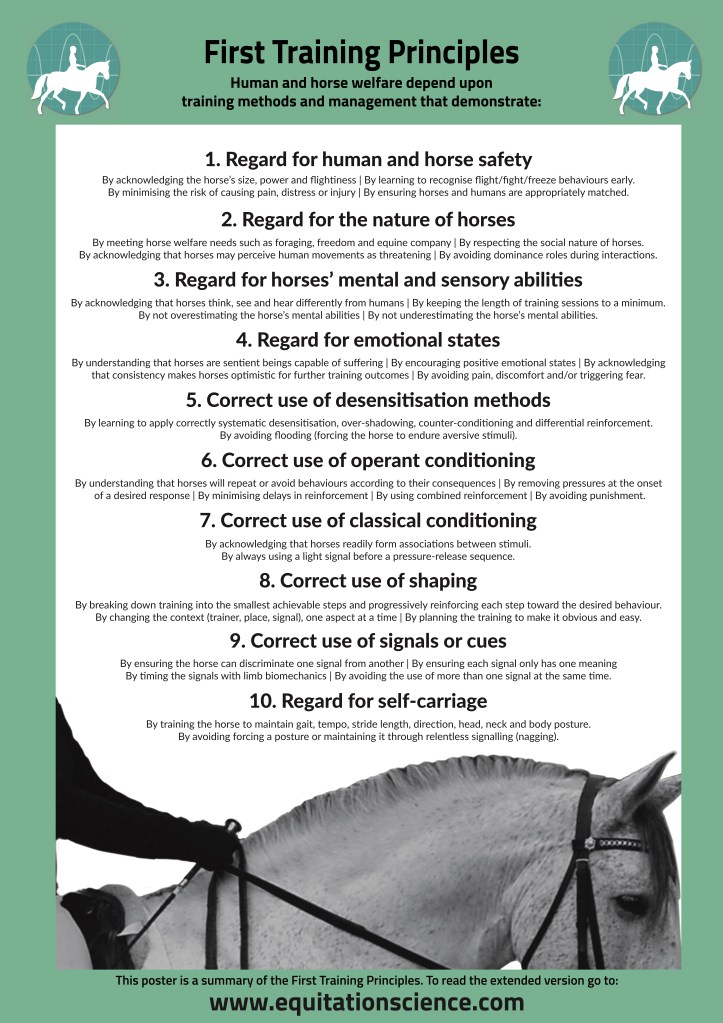
This information was adapted from the International Society for Equitation Science’s (ISES) 10 First Principles of Training.

What is Equitation Science?

Equitation Science is the measurement and interpretation of interactions between horses and their riders.

— Equitation Science (2010) Andrew McLean and Paul McGreevy

Equitation science is very exciting because it is bringing the advances of the training of most other animals into the horse world. Dog trainers, dolphin trainers, cat trainers almost without exception use Learning Theory.

Horse trainers are stuck in the world of tradition and trial-and-error.

Tradition is not a bad thing. The best horse trainers and riding coaches are already applying the principles of Learning Theory; that is why their training and teaching works. ‘Horse whisperers’, instructors, and the great modern trainers have made huge advances in the availability of horse knowledge.

But this is better.

What we can measure we can track, and what we track we can understand, and when we understand something we can explain it to others.

Equitation science opens up a conversation about how we can ethically use, train, and keep horses without subjecting them to abuse, accidental or not, so the horse industry does not tarnish its reputation.

Coaches can now teach their students how their horse thinks and learns, because when the student understands how the horse thinks about situations, they are much safer and can train the horse to become safer as well.

Trainers can put the tools into their clients’ hands to continue their horses training so the horse’s confusion is reduced and their welfare improved.

Science improves our ability to understand what we do with our horses and how we do it so we can get the best out of ourselves and our horses in the least invasive way possible.