What is Converse Conditioning?

In science, whenever a phenomenon is observed, it is helpful to give it a name so it is easier to refer to while investigating it. Converse conditioning is a more recently named training phenomenon that has not been studied yet. Let’s explore what it is.

In converse conditioning, a horse learns a new, opposing response to a previously learned cue. For example, if a horse is originally taught to accelerate from rein pressure, as is often the case with race horses, teaching that horse to decelerate from rein pressure would be an example of converse conditioning.

Perhaps when you started handling horses, you expected them to walk when you walked and stop when you stopped. But then you learned a bit more about horse behaviour and realized that would be confusing for the horse because there are some situations where you do not want the horse to move when you do (like saddling up or getting on for example!) and so you trained your horse to only respond to pressure or voice cues and not move when you move—this is another example of converse conditioning.

Both of the above examples were positive ones, where the outcome for the horse’s training is improved consistency and clarity. Converse conditioning also works the other way around.

If a horse is first taught to move quicker from a tap of the spurs, but then the rider changes that cue to mean slow down, the rider using his leg no longer always means acceleration. When to accelerate from leg pressure and when to decelerate will be hard for the horse to distinguish.

Another example of converse conditioning creating confusion or danger is when a horse that knows to decelerate from rein pressure is taught to simply shorten its neck to rein pressure. This may be done to try to have the horse move in a certain posture or frame, but causes confusion for the horse and could put the rider in danger.

So you see that converse conditioning is not necessarily good, nor necessarily bad, but it occurs frequently in horse training. It is therefore a good idea to understand what it is and in what scenario it will be useful and in what situations it may be detrimental.

Can you think of any more examples of converse conditioning? Comment your experiences below!

Feed the Spook

Spooking, or stepping quickly forwards or sideways without being cued to do so, is a natural behaviour in horses that can be very annoying and even frightening to us who handle and ride them. There are many opinions about how to make a horse less spooky, including:

° punishing the horse for spooking

° restraining the horse in the ‘spooky’ area

° lunging the horse in endless circles until it ceases to react

These three conventional responses to spookiness are actually not very effective. Punishment justifies the horse’s original fear, restraint uses the ‘flooding’ desensitization method which may be unethical, and lunging is only a temporary solution, often lasting only as long as the training session. What, then, to do?

In most situations, we cannot definitively say what causes a horse to spook, simply because we cannot ask the horse what scared it. All we can objectively know is what the horse did. For example, maybe the horse stepped suddenly to the right and accelerated. This information is much more useful than what the horse may have been scared of, as it suggests an operant training solution: step the horse to the left, and slow down. Since most spooks involve a turn and a change of speed, making certain that straightness and self-carriage of speed and line are trained thoroughly greatly reduces spookiness in many cases I see.

If the spook is still persistent after checking these basic responses, consider this very counterintuitive approach. Reward your horse when he spooks. Food rewards are incredibly powerful, but if you use food, also use a bridging cue like a clicker or saying ‘yes’ in a particular tone at the time of the spook, because you will not be able to deliver the food until a few seconds later, and would thus reward the wrong thing. Scratches may be useful, particularly around the withers, but with a highly aroused horse, the reward of touch may be significantly less meaningful.

What is the logic behind this approach? A spook is an automatic response, a behaviour that the horse has not thought about. It is a reflex. Therefore, when you reward, the reward is not linked with the spook in the horse’s mind, but rather with whatever he spooked at. In this way, the spooky thing or area is counter-conditioned, and the horse begins to associate that area with receiving food, and the spooks diminish.

The first time I tried this method, I was very tentative, not wanting to make the problem worse, of course. After only one training session where I fed every spook, both horses that I tried it on did not spook at all in the subsequent session, and continued to improve as I consistently applied the research. Learning theory is fascinating, is it not?

The Art of Shaping

Being able to shape a behaviour is imperative for any trainer. Without the ability to read our minds, animals can’t offer us a perfect, exactly correct behaviour on the first try, especially when the training progresses to complicated movements. Instead, the trainer has a picture in mind of the end behaviour and progressively rewards behaviours closer and closer to the end goal. This is called ‘successive approximation’.

Artists use this too, and an analogy from art may make the art of shaping easier to understand.

The End Goal

When an artist begins work, there is a goal. This goal may be a photograph they are trying to emulate, or a picture in their head.

The trainer must also have a goal as specific as a photograph, down to the last detail. Where is the horse’s focus, where are the feet, what exactly starts the behaviour and what exactly stops it?

The Basic Attempt

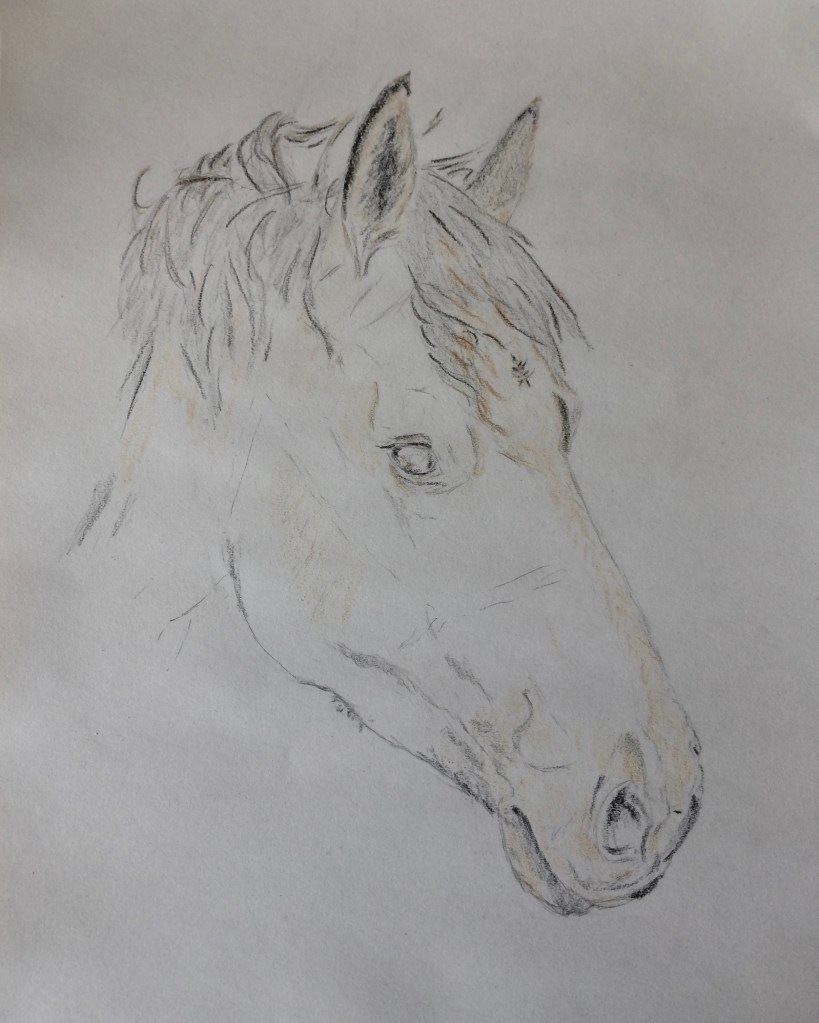
The artist starts with a rough sketch. It is in the right direction, it has many of the characteristics of the photo, but is also very different. Only a few details are present, and only faintly. There is a lot of work to be done.

The trainer sees the horse begin to understand the basic concept and rewards the horse’s tries.

Obedience

In art, this stage is the one where I notice mistakes in the original pencil sketch. After putting it away for a day or two, I see things that don’t look quite right or aren’t proportional. I fix these as I move on to adding bolder outlines of the key areas.

In training, obedience is the level that breaks most often when something goes wrong in training. This is the level to come back to and refine from.

Rhythm

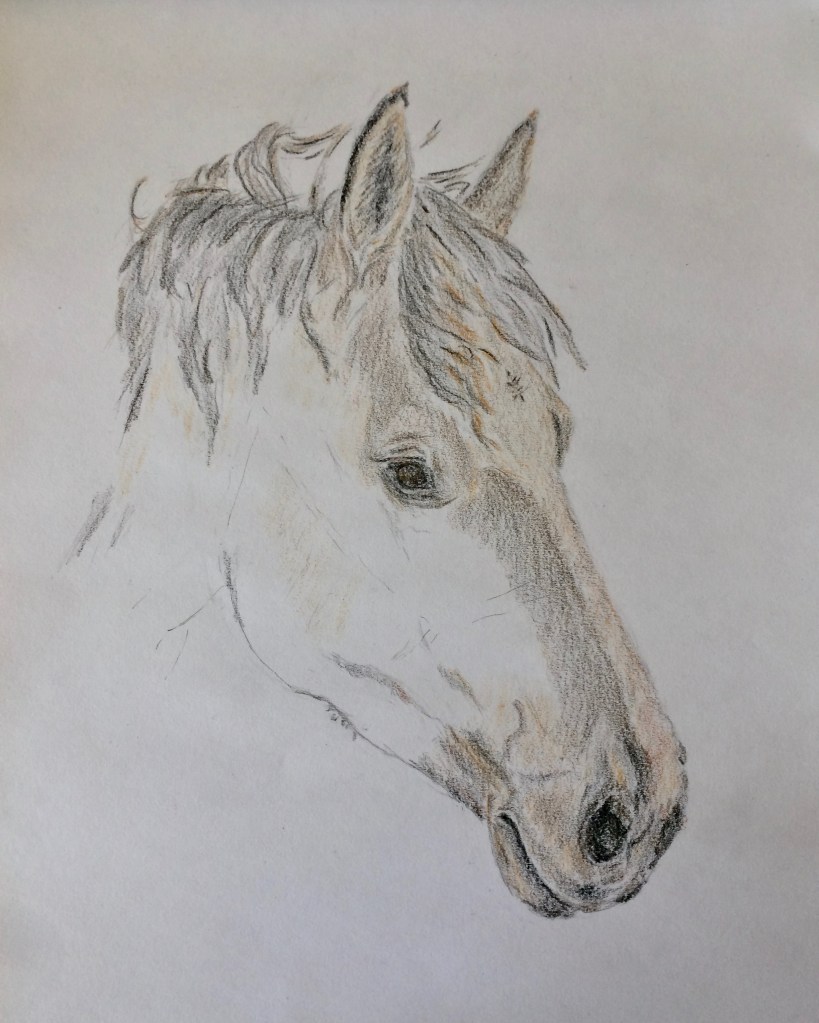
Each medium is different, but in art with coloured pencils you start with a base layer of the lightest colour to be found and progressively darken and shade from there.

In training, rhythm is the base layer, required for balance and cadence and willingness in any trained response.

Straightness

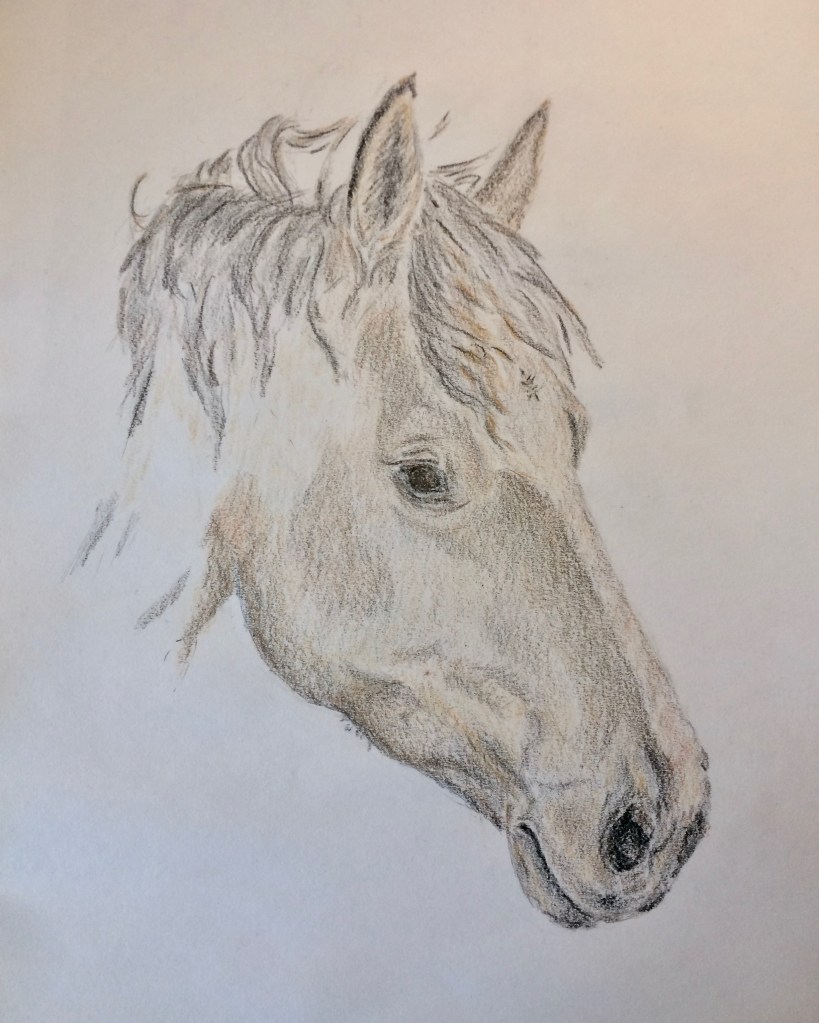
I don’t get the correct shade right away, and have to keep layering colours to produce the desired tone. Sometimes I have to go back to the base layer and add more in certain areas, sometimes using creativity when I am not getting quite the effect I want. There are often unexpected colours in a sketch. This one uses some blue and green!

This goes for training as well, when training rhythm in a movement, straightness is required to maintain it. When training straightness, rhythm is required to maintain it. Creative exercises help to progress this area of training.

Contact

Most places on the drawing are finished, or nearly so. Some refinement remains on the outline or key parts to make sure they stand out properly, and look just the way I want them.

Contact in training refines the last portions of the horse’s posture that have not yet fallen into place. Very often they are already partially present due to the previous correct training.

Proof

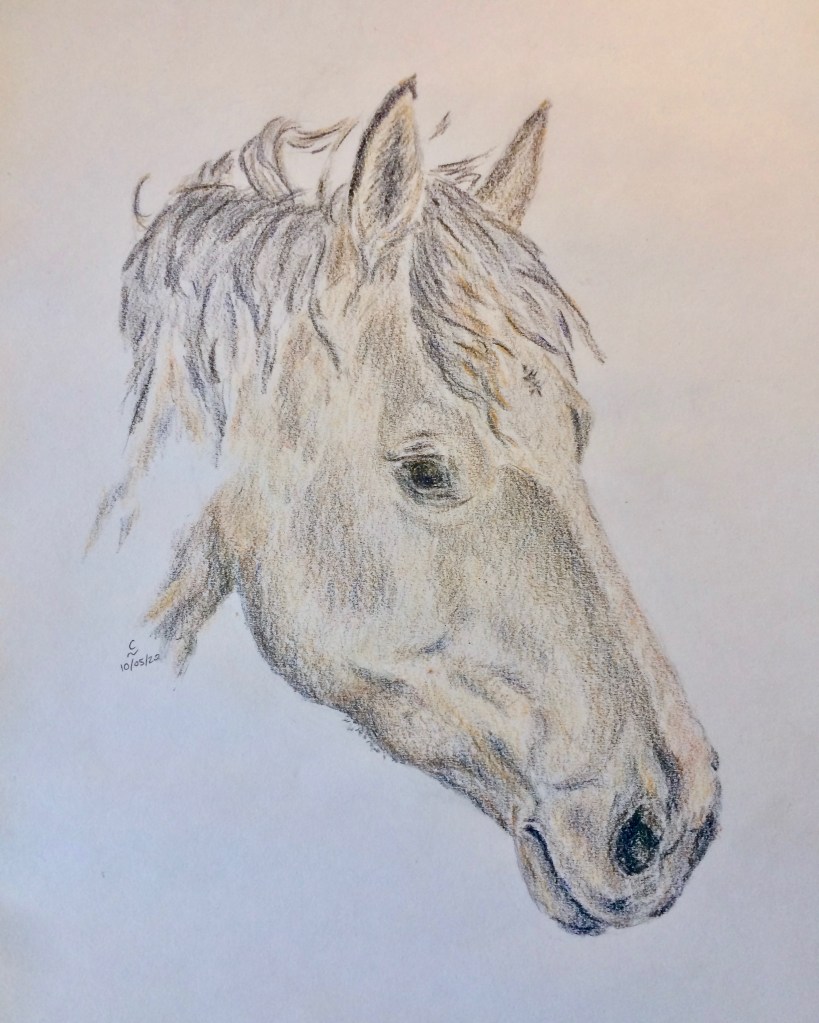
The drawing is complete. The last details are in place. The colour is true—and because the artist had a clear goal (photo) in the first place, the drawing is actually nicer than the original. The lighting is better, and there is no noisy background.

Shaping a behaviour slowly over time may actually give you a better result than you had pictured!

And that drawing of course is of Tesla, my beautiful mare.

Expanding the Window of Tolerance

The aim of good training is to expand the horse’s ‘window of tolerance‘ so the normal, every day stressors don’t bother him so much and there is room for his nervous system to take in and process unexpected or new experiences.

Horses are always moving between arousal states, from more aroused to less, and this often occurs within the window of tolerance so riders don’t often notice the process. But when these stimuli stack too high, they fill up the window and push the horse over the edge.

The rider’s reaction to that will either help to expand the window of tolerance, or push the horse farther above the threshold.

Growing the window can be done using three concepts: pendulation, titration, and self-regulation.

Pendulation

A pendulation is a swing or a cycle. It is returning to the point you started from. This tool to grow the window of tolerance requires patience. It takes time for the horse to return to a parasympathetic nervous state after being pushed up to or above the threshold of his window of tolerance and into a sympathetic state.

Adrenaline is the result of being pushed too far, and the half-life of adrenaline in the body is about 2.5 minutes. Allowing for a full pendulation of the horse’s nervous system then will take at least that long. Some wise old cowboys would call this ‘giving the horse some time to think’.

Trying to control the horse in a situation of high arousal can actually stack more stimuli up and push him over threshold. But this isn’t to say that you should leave your horse alone in a frightening situation. Backing off to where everyone was last comfortable, remaining calm, being reassuring, and waiting for signs of returning to a lower level of arousal is helpful. Being aware of stimulus stacking and trying to avoid stacking too high in the first place is even better. This takes time and practice.

Titration

Titration is a concept in where the balance is continuously adjusted by very tiny increments. In horse training, this is seen in progressing in a logical fashion through training, building in small steps through the training scale.

It can also be used when you start to see signs of stress responses in the horse. Consider what might be causing the response. Then use a tiny amount of that cause, not enough to make a response. Wait for pendulation and add a tiny bit more. In this way, the horse’s window of tolerance grows and expands through thoughtful training.

Self-regulation

This part is for the rider or trainer and not so much for the horse. Horses are actually quite good at self-regulation within their window of tolerance, which is why stress responses often seem out of the blue to riders.

Taking a step back from training when you feel yourself becoming annoyed can help to give clarity to the situation before you and your horse get pushed about threshold. It is better to take the time to grow the window than to risk narrowing it by doing the same old things in the same old way.

References

Draaisma, Rachaël (2018) Communication Ladder: Recovery after Tension and Shock. In: Language Signs and Calming Signals of Horses, Taylor & Francis Group.

Thompson, Kirrilly. (2020) Growing your Horse’s Window of Tolerance. Horses and People, May-June.

The Window of Tolerance

When your horse jumps out of his skin because of the door in the arena that he sees every day, what is going on? Is he just being silly? Does he know better? If so, you’re justified in the frustration this situation produces. But frustration never trained a horse. Is there a more helpful way to look at this behaviour?

Behaviourally speaking there is a better explanation. Every horse has a ‘window of tolerance’. This window isn’t static, it can be expanded through training and it can also be narrowed by stress. Inside this window the horse can operate well. Each stimulus the horse is exposed to can fill up the window a bit, and as he responds to it or relaxes his level of arousal within the window goes up or down.

When this window is already almost full due to various small (or large) stressors like being alone, pain, a windy day, a sudden noise, or a new training concept, the arena door can become the tiny thing that pushes him out of his window of tolerance. This is called stimulus stacking.

Stimulus stacking means that by the time the arena door became the last straw, the horse had already done a lot of self-regulating of the previous stressors that were narrowing his window. It can seem like out-of-window behaviour comes out of the blue, but there are actually many signs of increasing stress that you may notice beforehand.

Signs that the horse is trying to self-regulate very mild stress include yawning, blinking, and shaking the head or body. More stress produces displacement behaviours like licking objects, pawing, rubbing the head and neck, and sniffing the ground but not eating. Finally stress signals appear, such as characteristics of the equine pain face, startling, and frequent pooping. Pushing through all of these signs takes you to the threshold of the window of tolerance and beyond.

What is beyond the window of tolerance? Fight, flight, or freeze. This is where the horse’s parasympathetic nervous system is engaged. He is now beyond learning from the situation or responding to your cues.

This is why staying within the window of tolerance gets the most training work done. It is also desirable to grow the window of tolerance so the horse becomes more resilient to daily stressors and able to easily handle larger ones. Reading the horse’s body language and responding accordingly will help the horse to regulate his responses to the world around him, resulting in more relaxing and safer interactions between him and you!

In training my clients’ horses, this is what I aim to do—remain within the window of tolerance and grow it to produce a calm and relaxed horse that can cope well with the many stressors that come with a relationship with people.

References

Draaisma, Rachaël (2018) Communication Ladder: Fight or Flight. In: Language Signs and Calming Signals of Horses, Taylor & Francis Group.

Thompson, Kirrily. (2020) The Window of Tolerance. Horses and People, March-April.

Do Horses Recognize Themselves in a Mirror?

Few species are capable of recognizing themselves in a mirror. Many species interpret the image in the mirror as that of a conspecific. Being able to form a concept of ‘self’ requires higher mental ability. Do horses have this ability?

There are three stages an animal has to pass in a mirror self recognition test before the final stage of testing where a mark is applied to the animal in a region only visible with the help of a mirror to see if the animal attempts to remove the mark. Prior to this, the animal must show social responses towards the mirror. Then the animal explores the mirror, including looking behind it. Finally, to get to the stage of testing involving the mark, the animal must repeatedly test the mirror by looking at parts of its body that it cannot typically see without the mirror, or performing repetitive behaviours such as sticking out the tongue or moving in and out of the mirror’s range like playing peek-a-boo.

A few years ago there was an open access pilot study (https://doi.org/10.1371/journal.pone.0176717) using four horses and a large mirror to see if the horses would pass these four stages and recognize that it was themselves reflected in the mirror. At that point, the results were inconclusive, with horses recognizing that the reflected image did not behave like another horse but showing inconclusive behaviours for the remaining parts of the test.

More recently another open access study was conducted (https://doi.org/10.1007/s10071-021-01502-7) with more horses and different results. The mark was only used on the 11 horses (out of 14) that passed the first three stages of the testing as described above. A sham mark was used to ensure the horses were not detecting the mark through tactile means instead of actually seeing the coloured mark, and indeed most of the horses scratched more at the coloured mark than at the invisible one.

These results suggest that horses can develop an idea of self after some exploration of a mirror to satisfy themselves that it is not a conspecific. It is also possible that they recognized the mark on the face as unnatural and attempted to intentionally remove it.

Unfortunately, some reporters are touting this preliminary study with the headline that ‘horses worry about their looks,’ which is a sensational and inaccurate portrayal of the study results. Horses have previously been shown to be incapable of worrying about future events. Anxiety and stress are only triggered by context-specific memory. Reading the studies themselves, which are freely available, is much more accurate than reading reporters’ interpretations!

So don’t take my word for it either. Do some digging yourself, read the articles, and comment your thoughts and findings!

Is Your Horse Curious?

Is your horse (or the horse you ride, lease, borrow, love) curious? A new study shows that horses who are interested in new things and want to explore them actually learn better!

“Exploratory behaviour was unreinforced in the novel object tests and likely reflects the animal’s intrinsic motivation (i.e. curiosity), suggesting that this trait is favourable for learning performance.”

Coming up with ways to foster your horse’s curiosity could improve his whole outlook on life, including his interest in training.

“[these results] raise questions in relation to fostering of curiosity in animals and the impact that such manipulation may have on cognitive abilities.”

How can you foster your horse’s curiosity? I like to allow my horse to investigate things. When she looks worried about something, we stop and wait. Research shows that after about 13 seconds of observing something ‘scary’, horses become more willing to explore it. So we wait a bit, then I ask her to go a little closer. Soon she’s getting closer herself, sniffing or moving the object herself.

How do you enable your horse to be curious?

Christensen, J; Ahrendt, L; Malmkvist, J; and Nicol, C. (2021) Exploratory behaviour towards novel objects is associated with enhanced learning in young horses. Scientific Reports, 11:1428. Open access! Read the full article here: https://rdcu.be/cejm0

Does the Vet Like Seeing Your Horse?

Having the vet out for your horse isn’t an ideal scenario. Your horse is hurt, you’re stressed, it’s expensive, and now it’s going to take twice as long because the horse just won’t cooperate. Here’s how you can make the situation better for your horse, your vet, and yourself the next time your horse needs help.

The Problem

A recent study found that 95% of equine vets work with difficult horses at least monthly (Pearson et al, 2020). The kinds of dangerous behaviours they encounter, in order of prevalence, include: bargy or pushy horses; horses that won’t stand still or are needle-shy; head-shy or clipper-shy horses; horses that kick with a hind foot; horses that pull away; and horses that refuse to load. 81% of the vets surveyed had sustained at least one and up to thirty horse behaviour-related injuries in the past five years.

Whose Job is It?

Your vet is the professional, but that doesn’t mean they are going to train your horse to accept veterinary intervention. They need to get their job done, preferably without injury to themselves or further injury to the horse. The vets’ go-to method of getting the job done in this study was chemical restraint, with 99% of the vets placing it at the top of their list of useful restraint methods. Physical restraint came next, with everything from nose and neck twitches to bits, bridles, and holding up a leg (Pearson et al, 2020). Physical restraint can cause undue stress or injury to the horse, sometimes making the intervention even harder next time (McGreevy et al, 2018), and chemical restraint (sedation) can be expensive.

Unfortunately, methods of behaviour modification such as positive and negative reinforcement and overshadowing that encourage the horse to engage in the process and leave the horse more relaxed and better behaved for the next intervention (McLean, 2008), fell to the bottom of the list (Pearson et al, 2020). Only 7 and 8% of the vets considered negative reinforcement or overshadowing respectively to be very or fairly useful, and 50% considered negative reinforcement to be unhelpful or even useless! 67% had never heard of or did not understand overshadowing.

Clearly, if your vet is to find your horse a pleasure to work with rather than the cause of yet another injury, there is some work to do. It starts with how horses learn.

Your Part of The Solution

A horse is said to be under ‘stimulus control’ when the handler’s cues are responded to consistently, regardless of what is happening in the environment (McGreevy, 2010). Impossible, you say. Horses are horses. Stimulus control in a familiar environment is certainly possible, however, and with further training in different contexts, it becomes easier to control the horse even in a new or frightening situation, because the training is more consolidated. If, on the other hand, there is no training and the horse simply follows the handler if he feels like it, there is no base to fall back on when it is needed, such as in an emergency situation.

Applying learning theory to your horse’s ground training (and ridden training too) will create a horse that can calmly and promptly respond to light pressure cues, preventing some of the most common behaviours that veterinarians come up against, particularly barging, not standing, kicking, pulling away, and refusing to load.

The other common difficult behaviours are linked to a stimulus, like a needle, the clippers, or a trailer and are often found only in a veterinary context. These are the behaviours where overshadowing and combined reinforcement are most useful, provided the handler and veterinarian know how to apply them. Becoming familiar yourself with how your horse learns will set you up to be able to train him consistently so the foundation is there when you need it.

Your Vet’s Part of the Solution

There was an association seen in the study between the vet’s years of experience and the prevalence of unwanted behaviour he met with. More than half of the unwanted behaviours reduced in frequency based on the vet’s increasing experience. There are a few potential reasons for this.

First, more experienced vets have learned the hard way which handling methods tend to work safely and which do not (Pearson et al, 2020). These vets essentially learn about learning theory on the job. A second reason may be an increased willingness to turn to restraint methods earlier in the visit. Finally, vets consistently experiencing dangerous behaviours from their patients may leave the equine sector.

Gaining experience comes from being willing to learn. Once you’ve done your part in training your horse and learning about how you can help your horse learn and behave using learning theory, share with your vet. Although 79% of the surveyed vets thought they had a decent understanding of learning theory, only 10% were able to answer 5 out of the 6 test questions correctly. 46% reported receiving no training in learning theory (Pearson et al, 2020).

So, take your horse’s part. Instead of allowing potentially damaging physical restraint like an ear twitch for an injection, ask if you could use a page from learning theory’s book instead. Explain the method you’d like to use, and demonstrate your part if possible to show the horse can do it and you can handle it safely. 

Being an advocate for proper understanding and use of the horse’s learning processes can only help to create a positive experience for you, your vet, and your horse.

References

McGreevy, P and McLean, A. (2010) Equitation Science, Wiley- Blackwell, Oxon. 

McGreevy, P., Berger, J., de Brauwere, N., Doherty, O., Harrison, A., Fiedler, J., Jones, C., McDonnell, S., McLean, A., Nakonechny, L., Nicol, C., Preshaw, L., Thomson, P., Tzioumis, V., Webster, J., Wolfensohn, S., Yeates, J., Jones, B., 2018. Using the five domains model to assess the adverse impacts of husbandry, veterinary, and equitation interventions on horse welfare. Animals 8, 41.

McLean, A. (2008) Overshadowing: A Silver Lining to a Dark Cloud in Horse Training. Journal of Applied Animal Welfare Science 11:3, 236-248.

Pearson, G; Reardon, R; Keen, J; and Waran, N. (2020) Difficult horses—prevalence, approaches to management of and understanding of how they develop by equine veterinarians. Equine Veterinary Education. Open access: doi: 10.1111/eve.13354

Laddie: Horse Shy

As a five year old green-broke horse, Laddie’s only riding experience was alone on trails. When he was acquired for further training, the arena was a new experience and being ridden close to other horses was too. He shied at everything, and any time another horse came too close he would stop suddenly and run backwards, or shoot forwards. This anxiety made him tense and the rider often felt like he was about to buck until he got going.

Anxiety in a new situation is very normal. Controlling these reactions, however, is key to achieving relaxation and habituation (Principle 1). At first, when any correction of unwanted behaviour was made, no matter how mild, the anxiety increased and he seemed unable to trial new behaviour, showing a negative state of mind (Principle 4). Instead of starting directly with the shying and hyperactive behaviour, then, cues he already knew were used and his responses rewarded until he began to offer improved responses and show interest in figuring out what was required (Principle 3).

Then a new cue for ‘turn’ was installed using two light whip taps on the shoulder and transferred to the reins (Principle 7) so that any random turning, in a shy for example, could be corrected (Principle 6).

The ‘go’ cue was also re-installed, as sometimes it caused stopping or moving backwards instead of going forwards (Principle 9).

With these new cues, overshadowing was used (Principle 5) near areas of the arena that caused anxious responses until go and stop were light in those areas.

The number of horses in the arena was then increased and their proximity to Laddie was decreased using the same go, stop, and turn cues (Principle 8) until riding past another horse elicited no unasked change, and finally being ridden past produced no random movement either (Principle 10).

Laddie is now calmer about new situations, and is more willing to try new behaviour for a new cue, indicating a generally better state of mind (Principle 4).