Positive vs Negative Reinforcement in Horse Training: which is better?

We must begin with a definition of terms. Positive and negative reinforcement are two quadrants of operant conditioning. Positive reinforcement means adding (+) something a horse likes to make a behaviour more likely in future. This could be food or tactile rewards. Negative reinforcement means subtracting (-) something the horse doesn’t like to make a behaviour more likely in future. This is usually pressure, whether psychological or physical.

Among negative reinforcement trainers, there can be an attitude that reward is unnecessary.

Among positive reinforcement trainers, there can be an attitude that any pressure is bad.

Let’s analyze these two approaches and see if we can arrive at an optimal approach to horse training.

There is some research purporting to show that horses trained with positive (+) reinforcement have more optimistic affective states (mood) than horses trained with negative (-) reinforcement (Sankey et al, 2010). However, it must be remembered that during the shaping of a behaviour with positive reinforcement, reward must be withheld so the horse tries something more to achieve the next shaping criteria. This causes frustration, which is a pessimistic affective state. Also in the consolidation of a behaviour trained with positive reinforcement, reward must be moved onto a variable schedule, which can also induce frustration.

In the same study (Sankey et al, 2010), the positive reinforcement group of horses was taught to step back from the handler moving into the horse’s space. This is actually a fundamental example of negative reinforcement, in which the horse’s behaviour of stepping back removed the handler’s proximity. In this way, the study was not looking at ‘pure’ positive reinforcement, so the results cannot support the researchers’ hypothesis.

Indeed, a study of oxytocin levels in horses during foundation training using negative reinforcement found that as horses progressed through training, oxytocin levels increased, showing an increasingly optimistic affective state (Niittynen et al, 2022).

A more balanced view of the use of these two quadrants of operant conditioning, then, is clearly to make use of both. Positive reinforcement has the strength of being highly motivating for the horse especially when a learning task is difficult. Negative reinforcement has the strength of being predictable and controllable so that the horse experiences less frustration during training. A trainer who applies scientific knowledge of horse behaviour and learning, therefore, will be adept at applying both positive and negative reinforcement, which is known as combined reinforcement. In this way, the horse is always reinforced and often rewarded for correct behaviour, speeding up the rate of learning and creating an attachment between horse and trainer in the process. That special relationship between horse and human is, after all, what we are all looking for!

References:

Sankey, C., Richard-Yris, MA., Henry, S. et al. Reinforcement as a mediator of the perception of humans by horses (Equus caballus). Anim Cogn 13, 753–764 (2010). https://doi.org/10.1007/s10071-010-0326-9

Taru Niittynen, Veera Riihonen, Liza R. Moscovice and Sonja E. Koski, Acute changes in oxytocin predict behavioral responses to foundation training in horses, Applied Animal Behaviour Science, (2022) doi:https://doi.org/10.1016/j.applanim.2022.105707

Curiosity and Learning Ability in Horses

Many behaviour studies on domesticated animals have been limited to the negative side—how management practices causing fearfulness may be detrimental to horses’ cognition, welfare, and learning ability. A 2021 study explored a positive aspect of management and how fostering it could improve our horses’ ability to learn, resulting in an enriched life.

Fearfulness has been used in so many studies because it is easy to measure in horses. A horse on full alert, neck high, heart rate up, and not interested in food is easy to recognize. More positive emotions can be harder to distinguish. Novel objects usually induce some kind of fear response.

Novel objects (or in ordinary equestrian parlance, scary things) are ubiquitous around stables. Young horses especially may have never seen an enrichment toy like a ball, or the typical inside of a barn. Even a bucket being where it wasn’t yesterday can be ‘novel’. In this study, how young horses approached an interaction with a novel object was strongly predictive of learning ability in two very different learning tasks. Instead of focusing on fearfulness and its detrimental effects, the researchers looked for curiosity and whether it had any positive effects.

The animals that showed curiosity towards the novel object scored better in learning tasks. Curiosity is an intrinsic desire to investigate, even when a reward is not immediately forthcoming from the investigation. The animal is interested for interest’s sake.

Encouragingly, the authors found that fearfulness measures did not predict the horses’ performance in the learning tasks. It is important to note that fear was not induced in the novel object tests, however; the horse was given motivation to pass the object and left to do so if it was going to. No pressure was applied, which tends to increase fearfulness in a novel situation.

Instead, they found that the more curious horses, which tended to explore the new object, even if they had previously shown fearfulness, performed better on the learning tests than the others that did not explore.

Could encouraging curious behaviours in horses, or at least not hindering them, contribute to better horse-human relationships through better learning performance and enriched domestic life?

Read the full open access article here: https://rdcu.be/cejm0

The Art of Shaping

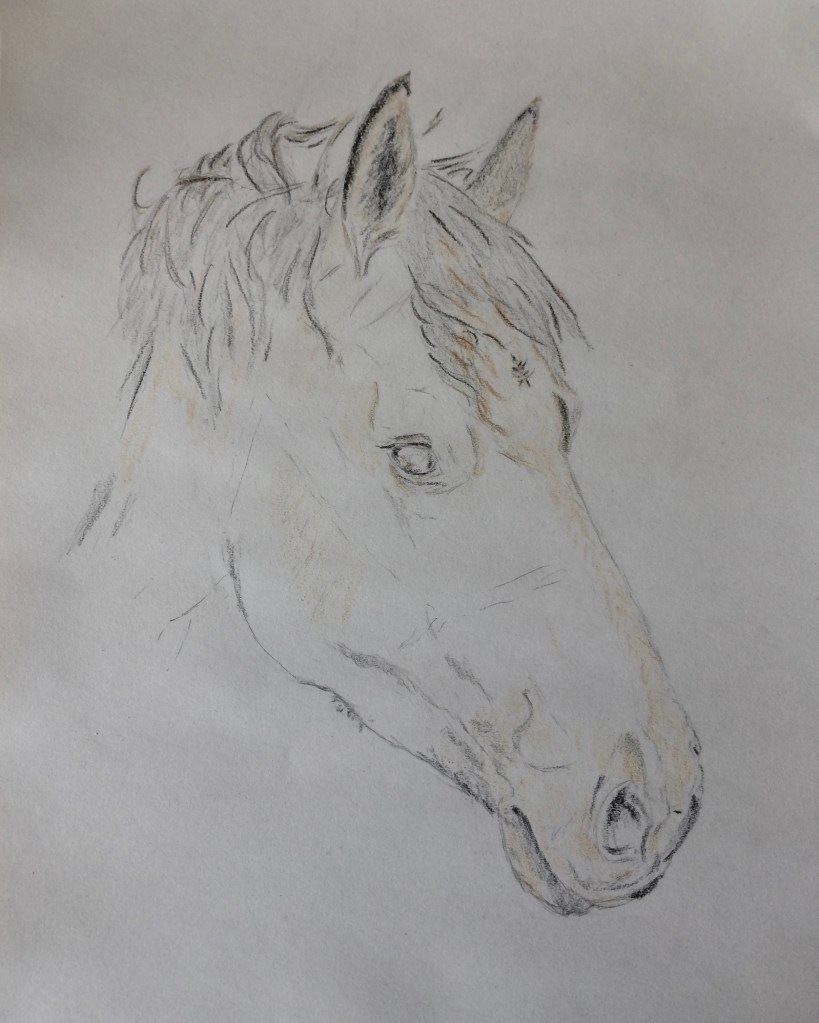
Being able to shape a behaviour is imperative for any trainer. Without the ability to read our minds, animals can’t offer us a perfect, exactly correct behaviour on the first try, especially when the training progresses to complicated movements. Instead, the trainer has a picture in mind of the end behaviour and progressively rewards behaviours closer and closer to the end goal. This is called ‘successive approximation’.

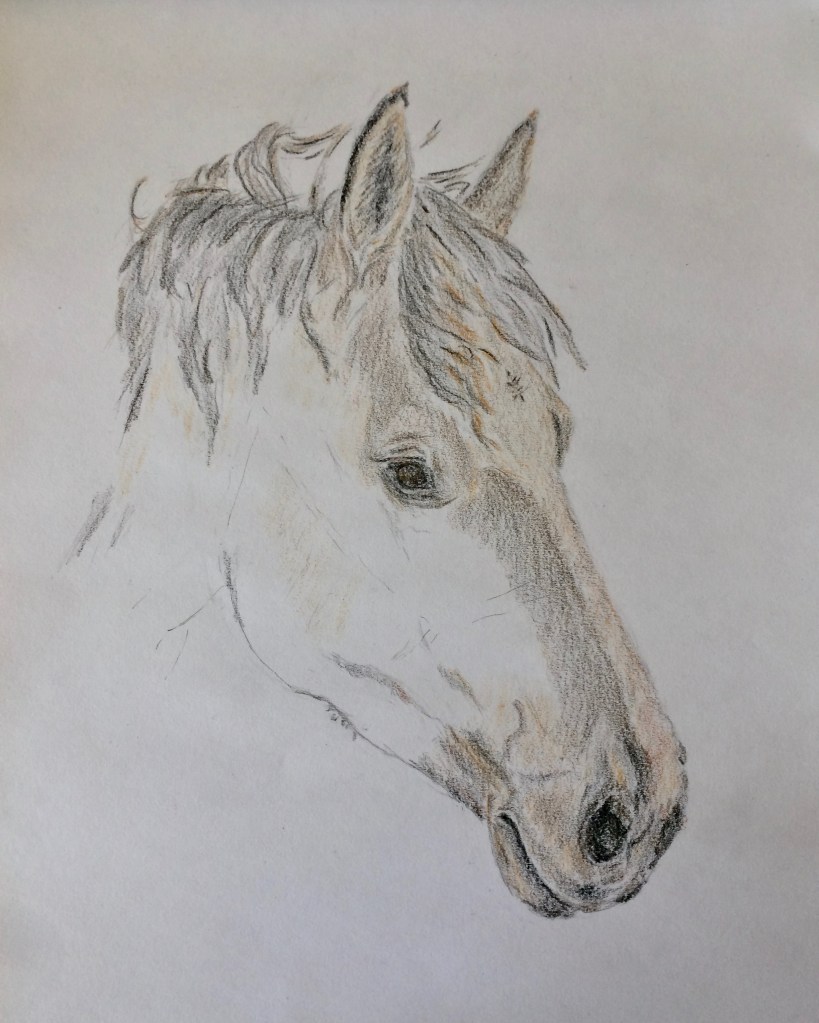
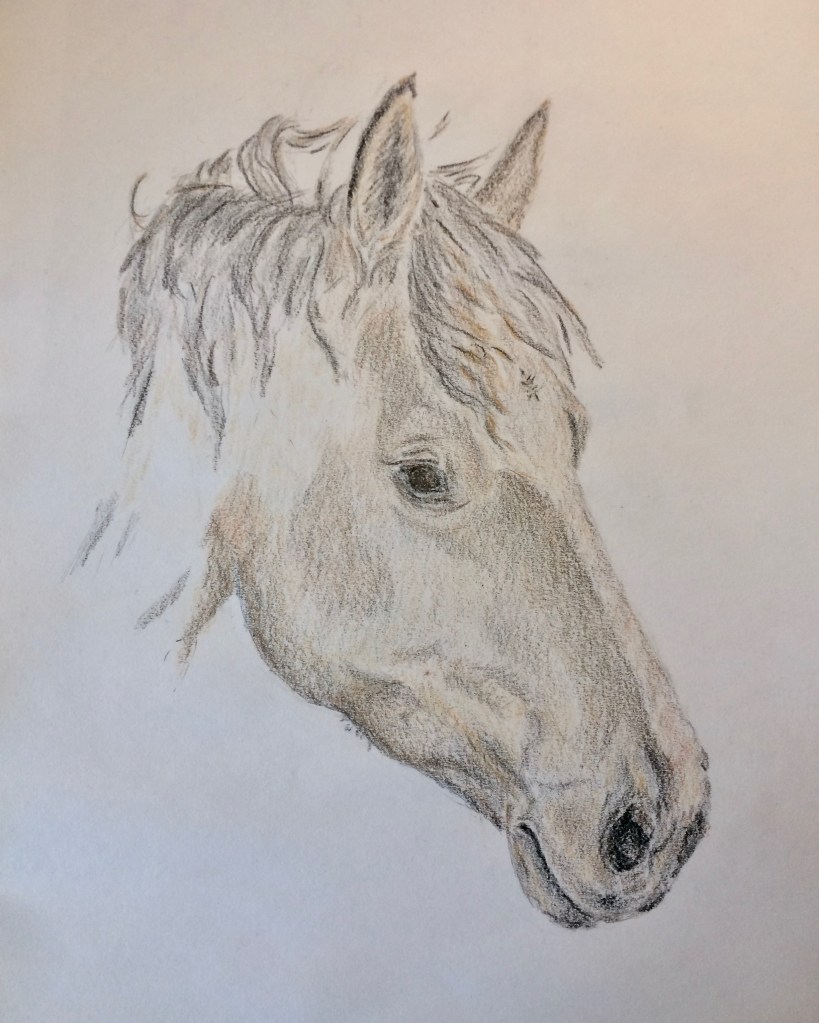
Artists use this too, and an analogy from art may make the art of shaping easier to understand.

The End Goal

When an artist begins work, there is a goal. This goal may be a photograph they are trying to emulate, or a picture in their head.

The trainer must also have a goal as specific as a photograph, down to the last detail. Where is the horse’s focus, where are the feet, what exactly starts the behaviour and what exactly stops it?

The Basic Attempt

The artist starts with a rough sketch. It is in the right direction, it has many of the characteristics of the photo, but is also very different. Only a few details are present, and only faintly. There is a lot of work to be done.

The trainer sees the horse begin to understand the basic concept and rewards the horse’s tries.

Obedience

In art, this stage is the one where I notice mistakes in the original pencil sketch. After putting it away for a day or two, I see things that don’t look quite right or aren’t proportional. I fix these as I move on to adding bolder outlines of the key areas.

In training, obedience is the level that breaks most often when something goes wrong in training. This is the level to come back to and refine from.

Rhythm

Each medium is different, but in art with coloured pencils you start with a base layer of the lightest colour to be found and progressively darken and shade from there.

In training, rhythm is the base layer, required for balance and cadence and willingness in any trained response.

Straightness

I don’t get the correct shade right away, and have to keep layering colours to produce the desired tone. Sometimes I have to go back to the base layer and add more in certain areas, sometimes using creativity when I am not getting quite the effect I want. There are often unexpected colours in a sketch. This one uses some blue and green!

This goes for training as well, when training rhythm in a movement, straightness is required to maintain it. When training straightness, rhythm is required to maintain it. Creative exercises help to progress this area of training.

Contact

Most places on the drawing are finished, or nearly so. Some refinement remains on the outline or key parts to make sure they stand out properly, and look just the way I want them.

Contact in training refines the last portions of the horse’s posture that have not yet fallen into place. Very often they are already partially present due to the previous correct training.

Proof

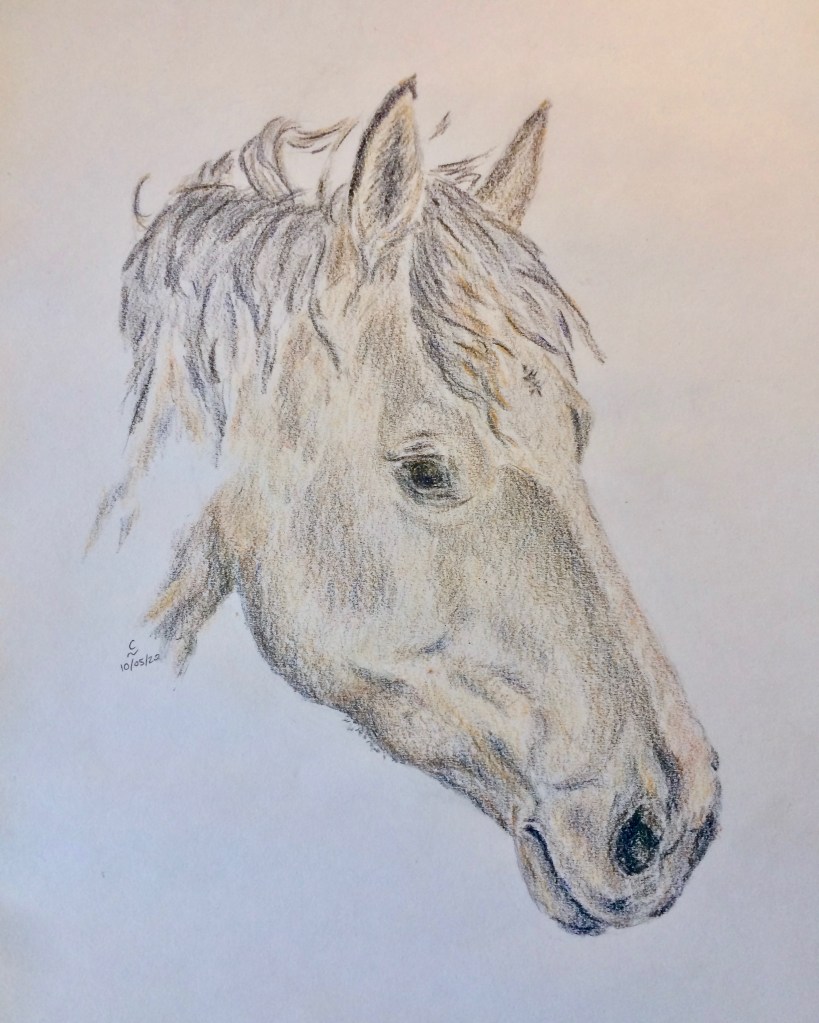
The drawing is complete. The last details are in place. The colour is true—and because the artist had a clear goal (photo) in the first place, the drawing is actually nicer than the original. The lighting is better, and there is no noisy background.

Shaping a behaviour slowly over time may actually give you a better result than you had pictured!

And that drawing of course is of Tesla, my beautiful mare.

What’s in a Training Method?

I used to think that dabbling in this method or that style would make me a really good rider and trainer.

What it made me was really confused.

Have you noticed the really good trainers and riders have a style all their own? Everyone then does interviews and articles, and watches them carefully, trying to copy them and create the same results. But it doesn’t work that way.

The many distinctive methods we see all around the world derive from what makes sense to the person who started it. All methods work on the exact same principles, or they wouldn’t work. Each horse and each trainer are individuals, and different words and phrases make sense to different people, so we get different ways of explaining things and different ways of creating behaviour.

That is why you can’t just watch someone and copy them. The great trainer has spent years filtering. They’ve worked out a system for processing all the opinions and styles that come their way, and choosing what they understand and what the horses they work with understand. So, you say, that’s what I need to do. Read and watch everything and filter it down to what works for me and my particular horse.

If only it were that simple. You’d need about 20 lifetimes to even scratch the surface of all the methods and ideas that are out there. That’s exactly why I got so confused. And that is exactly why I was so drawn to equitation science.

Equitation science is a filter. A system for evaluating what is going to work and what isn’t so you don’t have to try it all and end up just as confused as your horse has become due to your dabbling. There is always more to learn, and you can always learn something from everybody (even if it’s what not to do). But having a way to process all the information is a necessity, or you end up mired down in it all, unable to see your way clearly forward.

From years of research, there are certain things we know horses in general learn well from, and things that in general are best avoided because they are either ineffective or inhumane. Why not use that great body of knowledge acquired in previous generations to evaluate what is likely to work and what is likely not to before going and experimenting on your horse?

Now that I have been steeped in the equitation science world for a few years, patterns are starting to emerge. Each time I take in a training horse, I notice these patterns and can start to make predictions about what the horse might do next, and what my next training steps will be, and whether to just ignore a behaviour or work on it actively. Equitation science accelerated my ability to do this while I’m still relatively young. I don’t have to have lived 9 lives and gained all the experience myself. Andrew McLean and the other scientists who pioneered equitation science have done that before me.

Implications of Cribbing—Not All Bad

Cribbing is a sterotypical behaviour, meaning it is repetitive, persistent, and abnormal. There are also other oral stereotypies, including windsucking and wood chewing.

A long time ago, cribbing used to be called a ‘vice’ and was regarded as a plague in the barn that could be ‘caught’ by other horses. We know now that this is not true.

Then it was hypothesized that poor or unnatural living conditions were the cause of cribbing and other oral stereotypies. This is not far from the mark.

Recent research however is showing that horses displaying oral stereotypical behaviour actually have a different neural phenotype when compared to ‘normal’ horses that affects how dopamine interacts with the basal ganglia of the brain. This situation is brought about by stressors during development.

Therefore, the genetics of the horse and the stressors the horse experiences combine to create the stereotypical behaviour.

The Negative Implications of Cribbing

Horses that crib destroy fencing and anything else they can get their teeth on. Stable managers have tried many creative solutions to prevent their barns from being eaten down. Leaving a designated spot that the horse is ‘allowed’ to crib may be beneficial, as it is the horse’s way of coping with the altered dopamine transmission in the brain.

Teeth suffer more wear and tear in the cribbing horse, but with adequate and potentially more frequent veterinary dental care, this drawback can be managed.

To anyone who doesn’t know the causes in the particular horse, the sight and sound of a cribbing horse can be distressing. Being able to explain the phenomenon with sensitivity to a layperson is a beneficial skill.

Managing Cribbing

Because cribbing arises from stressors, the moment someone notices a horse cribbing that doesn’t usually crib, taking a serious look at its environment and making some changes could eliminate the behaviour and improve the horse’s welfare.

Common stressors in horses include social isolation, insufficient time spent foraging, lack of necessary nutrients, and inconsistent handling.

Ensuring that stressors are reduced as much as possible may reduce the horse’s drive to find other ways to cope.

The Positive Implications of Cribbing

If your horse cribs habitually, there is no need to despair. There are also positive aspects of the neural phenotype responsible for the behaviour!

Horses that crib form stronger habits more quickly. They will move from Response-Outcome learning to Stimulus-Response learning more quickly than the typical ‘normal’ horse. This has implications for the effectiveness of classical conditioning, because regardless of the outcome of the behaviour, the stimulus or cue will continue to produce it. Therefore, even if a new rider continually loses balance and pulls on the horse’s mouth during a jumping effort, effectively punishing it, if the habit of jumping on cue is established the horse will continue to do so, regardless of the unintended punishment.

Cribbing horses are also less sensitive to delays between the response and the outcome. This means a reward for correct behaviour doesn’t have to come right away for them to still make the connection and learn or retain the behaviour. Therefore, even if a new rider delays the release of the reins until after the horse has already stopped, the horse will continue stopping on cue in spite of the delayed reward.

Conclusion

Is it any surprise, given all of these characteristics of the crib-biting horse that every lesson barn has one or two (or more) horses that crib? Being persistent in their habits means these horses aren’t untrained by all of the new riders they teach every day. They are less frustrated by inconsistent timing of rewards for proper behaviour, and aren’t put off by inadvertent punishment that comes from inexperience.

Horses that perform stereotypical behaviours have excellent perseverance. These strong habits can create excellent, reliable horses.

References

Parker, MO (2008) “Behavioural Correlates of the Equine Stereotypy Phenotype”, University of Southampton, School of Psychology, PhD Thesis

Better Riding=Better Relationship

A recent study examined how riders’ pelvic movement and balance on an exercise ball correlated with their riding ability and harmony with their horse and with their horses’ welfare while riding.

Three gymnastic ball exercises were evaluated, and two of them were found to be positively correlated with riders who moved best with their horses and whose horses expressed the least conflict behaviours. That means the riders who were better at those two exercises were better riders and caused their horses less confusion.

Get your exercise ball and give these a try:

  1. Sitting on an exercise ball with arms crossed in front of you, wrist to elbow, roll the pelvis from side to side without tipping your shoulders and without moving your feet. You’ll lift the right hip and lower the left, then lift the left and lower the right.
  2. In the same position on the ball, roll the ball in a circle with your pelvis, to the right and then to the left, controlling the motion of the ball throughout the circle. Again, maintain the feet flat on the ground and the upper body stable.

Riders whose performance of these exercises scored high also scored high for harmony with their horse while riding, and their horses worked at higher heart rates with fewer conflict behaviours. That means the horses were working more correctly with less confusion, which improves the relationship between horse and rider!

The third exercise examined was a balance exercise where riders were asked to extend their arms horizontally in front and then lift their feet off the ground, attempting to balance for 30 seconds. Interestingly, riders who scored well on this exercise showed a negative correlation with harmony while riding. The authors hypothesized that the different muscle contractions required for balancing in this position versus balancing in a riding position made the exercise unhelpful for riding. 

Uldahl, M; Christensen, J; Clayton, H. (2021) Relationships between the Rider’s Pelvic Mobility and Balance on a Gymnastic Ball with Equestrian Skills and Effects on Horse Welfare. Animals 11:2, 453.

Better Relationship, Easier Handling: Effect of Training Method

A recent study investigated whether the human-horse bond could be considered ‘attachment’ by the scientific definition of the term. This involves security and comfort being derived from the relationship.

The relationship and attachment of dogs and cats to humans has been studied much more than that of horses, but this preliminary study with 12 horses is the starting place for more research in future.

Methods

The twelve horses were assessed before the training began in an arena with four novel objects and two unfamiliar humans. This assessed their fear responses to new situations and whether they found the presence of unfamiliar humans to be reassuring.

The horses were then trained over a period of ten days for fifteen minutes by the same trainer in ten simple tasks including stepping forward, stopping, standing still, and moving either the shoulders or the hips sideways. One group of horses was trained this using only negative reinforcement (the removal of pressure to reinforce the correct response). The other two groups were trained with combined reinforcement, which is negative reinforcement combined with positive reinforcement (the addition of something pleasant as a reward for a correct response). One combined reinforcement group had food rewards, and the other had wither scratching as a reward.

A post training test was conducted with four new novel objects and two people near the objects. One of these people was unfamiliar, and the other was the horses’ trainer so that it could be assessed if the horse showed attachment behaviours towards the familiar person. The researchers also wanted to see if the method of training used affected the horses’ responses to novel objects.

Lastly, a handling test was conducted consisting of five challenging and potentially fear inducing situations that the horse was led through by an unfamiliar handler or by the trainer to investigate effect of training method and familiarity of the human on the horses’ reactions.

Results

The researchers were unable to find a difference between horse behaviour toward the trainer versus behaviour toward the stranger between the pre- and post-tests. Horses that were willing to investigate the novel objects in the pre- test did so also in the post-test. Their heart rates, however, were significantly lower in the post-test, indicative either of the horse getting used to the testing scenario, or perhaps showing an effect of correct training in producing relaxation, which has been demonstrated in other studies. During the handling test, there was no difference in measured behaviours when being handled by the trainer versus the stranger.

There is not enough evidence from this study to conclude that scientific attachment occurs between horses and humans, but the reasons for this may be several.

  • There were few training sessions. Horses may take longer to form an attachment than other species.
  • The horses were lesson horses. They were therefore frequently handled by many humans and may have generalized to consider all humans as positive.
  • This was a pilot study. There were only 12 horses used, which is a good start but further research is required.

Reference

Hartmann, E; Rehn, T; Christensen, JW; Nielsen, PP; and McGreevy, P. (2021) From the Horse’s Perspective: Investigating Attachment Behaviour and the Effect of Training Method on Fear Reactions and Ease of Handling—A Pilot Study. Animals 11: 457. Open Access: https://www.mdpi.com/2076-2615/11/2/457

Teaching Yield

It’s cold. There’s no better time to do some slow, finicky training like lateral movements. It’ll improve performance when you can get sweaty again!

Materials

Dressage whip

Horse in a halter or bridle

Helmet and Gloves

Prerequisites

To learn this exercise successfully, your horse needs to know to not run away from the whip, how to go from two light whip taps, and how to stop from light halter or bit pressure. If he doesn’t, go back to this post first: https://clairetyhorsemanship.ca/2021/01/27/training-exercise-slow-down/

Training Yield

Using a series of light taps with a dressage whip on your horse’s stifle, get him to step away from the taps with that leg by quitting the taps as soon as he moves the leg away, crossing it underneath himself in front of the other one. Reward only one step, or even half a step at first, especially if your horse is prone to getting anxious. Next walk forward five steps and stop. This will set up his legs to be in a good position for your next ask. Ask again for one step to the side. See how precise you can be with one step sideways and five steps forward.

Teach this on both sides.

It will be easier to transfer this to your riding once you can do this sequence calmly, slowly, and thoughtfully. Sidepass, leg yield, haunches in, shoulder in, renvers, and pirouettes all use yield to some extent!

Training Exercise: Slow Down!

You’ll see it in sales ads: forward horse, requires experienced rider.

Read: this horse has a tendency to go faster than you’d like and doesn’t slow down if you want to.

This isn’t a safe problem to have with a horse, and it can be scary too.

Here is a simple training exercise to begin installing better brakes on a more-go-than-whoa horse.

Set Up

You’ll want a safe, enclosed area to work in. This exercise can be done ridden or on the ground, depending on the horse’s and handler’s ability levels. For a horse that bolts, the smaller the area, the better. Always wear a helmet, appropriate shoes, and gloves.

Exercise

You will walk the horse forward exactly six steps of the forelegs and then stop. No more, no less. Not five, not five and a half, six. Right front leg is one, left front leg is two, and so on.

This will take some planning ahead on your part. You will begin cuing for a stop as step number four is in the air. If you are on the ground, walking backwards can be helpful so you can see the front legs.

Step four: light stop pressure begins. Always start with light pressure.

Step five: pressure increases smoothly and steadily to a point that motivates the horse to stop.

Step six: release pressure completely.

Aim for three improved repetitions before working on something else or finishing the session.

Troubleshooting

Horse keeps walking after step six: It is likely for the first few repetitions that the forward horse will continue walking through the pressure past the sixth step. Continue to increase pressure until the stop is achieved and release immediately. Next time, make sure your pressure gets up to the effective level faster during the fifth step so you can release on the sixth.

Horse takes five steps: You can use less pressure. Try maintaining the same light pressure you started with on the fourth step instead of increasing pressure. Play with the amount of pressure needed to reach exactly six steps.

Horse walks again immediately after stopping: Make sure you aren’t releasing pressure too early. Apply pressure to stop again if he moves before you cue. Also make sure you aren’t expecting the horse to stay immobile for too long. When just starting the exercise, one to two seconds is long enough. Then have him take six steps forward again. As he gets better at stopping, you can increase the time you expect him to wait.

But I want the horse to stop when I say whoa/lean back/use other classical cue: Classically conditioned cues like voice or seat cues are wonderful. Every horse should learn them. But if the horse does not respond to light pressure, teaching a reliable classically conditioned cue is not possible. In a stressful or different situation, the cue will fade. I always teach response to light pressure first. Then it is very easy to add a voice or seat cue that is reliable.

Effective Rewards

Behaviour that is reinforced is likely to be repeated. This is how horses are trained. There are two kinds of reinforcers, primary reinforcers and secondary reinforcers.

Primary reinforcers are valuable to the horse of themselves. Secondary reinforcers are rewarding only when they are consistently paired with a primary reinforcer. Let’s look at some examples.

Primary ReinforcersSecondary Reinforcers
Release of pressureThe ‘Click’ in clicker training
FoodVocal rewards (good boy)

Another commonly used method of reinforcing behaviour is petting or scratching the horse, often near the withers. This has been reported to lower the horse’s heart rate, and many horses appear to enjoy the scratch, closing their eyes, wiggling their lips, and extending their necks.

Is tactile reinforcement primary or secondary?

A 2010 study using 20 horses trained them to stand still at a vocal command for increasing duration up to a minute. Half were rewarded for correct responses with food and half were rewarded with vigorous wither scratching. The researchers tested the horses’ relationship to humans before and after the training, examining latency to approach a stationary person and how long the horse stayed close to them. They also looked at the horses’ ability to perform the learned behaviour after the training was over.

Interestingly, they found that the wither scratch group did not learn as well as the food reward group. They were unable to stand still for as long, and did not learn as fast. The food reward group also approached a stationary human faster after training and stayed closer for longer than the tactile reward group, though both groups had started out scoring the same for approach latency and time in proximity on the relationship tests.

The researchers suggested that tactile rewards may have been given too much credit, and that carefully used food rewards are more efficient in terms of both horse learning and relationship building.

Some horses really enjoy touch, but all of them seem to enjoy food! Learning how to use food well in training seems like a logical choice from the results of this study.

The study, The Way to a Man’s Heart is Through His Stomach: What About Horses? by Sankey, C; Henry, S; Górecka-Bruzda, A; Richard-Yris, M-A; and Hausberger, M was published by PLoS ONE in November 2010, Volume 5, Issue 11, and can be found for free online here: https://journals.plos.org/plosone/article?id=10.1371/journal.pone.0015446