Posts

What is Converse Conditioning?

In science, whenever a phenomenon is observed, it is helpful to give it a name so it is easier to refer to while investigating it. Converse conditioning is a more recently named training phenomenon that has not been studied yet. Let’s explore what it is.

In converse conditioning, a horse learns a new, opposing response to a previously learned cue. For example, if a horse is originally taught to accelerate from rein pressure, as is often the case with race horses, teaching that horse to decelerate from rein pressure would be an example of converse conditioning.

Perhaps when you started handling horses, you expected them to walk when you walked and stop when you stopped. But then you learned a bit more about horse behaviour and realized that would be confusing for the horse because there are some situations where you do not want the horse to move when you do (like saddling up or getting on for example!) and so you trained your horse to only respond to pressure or voice cues and not move when you move—this is another example of converse conditioning.

Both of the above examples were positive ones, where the outcome for the horse’s training is improved consistency and clarity. Converse conditioning also works the other way around.

If a horse is first taught to move quicker from a tap of the spurs, but then the rider changes that cue to mean slow down, the rider using his leg no longer always means acceleration. When to accelerate from leg pressure and when to decelerate will be hard for the horse to distinguish.

Another example of converse conditioning creating confusion or danger is when a horse that knows to decelerate from rein pressure is taught to simply shorten its neck to rein pressure. This may be done to try to have the horse move in a certain posture or frame, but causes confusion for the horse and could put the rider in danger.

So you see that converse conditioning is not necessarily good, nor necessarily bad, but it occurs frequently in horse training. It is therefore a good idea to understand what it is and in what scenario it will be useful and in what situations it may be detrimental.

Can you think of any more examples of converse conditioning? Comment your experiences below!

Positive vs Negative Reinforcement in Horse Training: which is better?

We must begin with a definition of terms. Positive and negative reinforcement are two quadrants of operant conditioning. Positive reinforcement means adding (+) something a horse likes to make a behaviour more likely in future. This could be food or tactile rewards. Negative reinforcement means subtracting (-) something the horse doesn’t like to make a behaviour more likely in future. This is usually pressure, whether psychological or physical.

Among negative reinforcement trainers, there can be an attitude that reward is unnecessary.

Among positive reinforcement trainers, there can be an attitude that any pressure is bad.

Let’s analyze these two approaches and see if we can arrive at an optimal approach to horse training.

There is some research purporting to show that horses trained with positive (+) reinforcement have more optimistic affective states (mood) than horses trained with negative (-) reinforcement (Sankey et al, 2010). However, it must be remembered that during the shaping of a behaviour with positive reinforcement, reward must be withheld so the horse tries something more to achieve the next shaping criteria. This causes frustration, which is a pessimistic affective state. Also in the consolidation of a behaviour trained with positive reinforcement, reward must be moved onto a variable schedule, which can also induce frustration.

In the same study (Sankey et al, 2010), the positive reinforcement group of horses was taught to step back from the handler moving into the horse’s space. This is actually a fundamental example of negative reinforcement, in which the horse’s behaviour of stepping back removed the handler’s proximity. In this way, the study was not looking at ‘pure’ positive reinforcement, so the results cannot support the researchers’ hypothesis.

Indeed, a study of oxytocin levels in horses during foundation training using negative reinforcement found that as horses progressed through training, oxytocin levels increased, showing an increasingly optimistic affective state (Niittynen et al, 2022).

A more balanced view of the use of these two quadrants of operant conditioning, then, is clearly to make use of both. Positive reinforcement has the strength of being highly motivating for the horse especially when a learning task is difficult. Negative reinforcement has the strength of being predictable and controllable so that the horse experiences less frustration during training. A trainer who applies scientific knowledge of horse behaviour and learning, therefore, will be adept at applying both positive and negative reinforcement, which is known as combined reinforcement. In this way, the horse is always reinforced and often rewarded for correct behaviour, speeding up the rate of learning and creating an attachment between horse and trainer in the process. That special relationship between horse and human is, after all, what we are all looking for!

References:

Sankey, C., Richard-Yris, MA., Henry, S. et al. Reinforcement as a mediator of the perception of humans by horses (Equus caballus). Anim Cogn 13, 753–764 (2010). https://doi.org/10.1007/s10071-010-0326-9

Taru Niittynen, Veera Riihonen, Liza R. Moscovice and Sonja E. Koski, Acute changes in oxytocin predict behavioral responses to foundation training in horses, Applied Animal Behaviour Science, (2022) doi:https://doi.org/10.1016/j.applanim.2022.105707

What Equitation Science Can Do for You

If you’re a horse lover, chances are you’ve spent countless hours learning about these majestic creatures. But in your journey, you’ve probably encountered a fair share of conflicting advice—one expert swears by training with treats, while another says they’re a terrible idea. One trainer insists rope halters are the key to success, while another argues they’re too harsh. And then there’s the endless debate about bridles vs. bareback riding with a neck rope.

With so many differing opinions and techniques—from the practices of different disciplines to the personalities of passionate horse people—it’s easy to feel overwhelmed. And here’s the thing: if you’re confused about how to approach training, how can your horse possibly understand what you want from them?

This is where equitation science comes in. It’s not just a set of techniques or trends. Rather, equitation science is the study of how horses think, learn, and respond. It’s about using science to understand your horse’s behavior in measurable ways, breaking down the “why” and “how” behind every action, and offering insight into what works and what doesn’t.

Equitation science provides you with a bird’s-eye view of the horse-human relationship. Instead of getting bogged down in the specific methods of individual training styles, you can begin to see the broader patterns and principles that underlie effective, compassionate interaction with horses. It shows you the true science behind the techniques you already use—perhaps without fully understanding their impact—and helps you improve those techniques.

Unlike a particular training method or discipline, equitation science transcends them all. It’s universal, speaking to every rider and trainer, regardless of their background or approach. And in a world where the horse industry feels divided and under scrutiny, equitation science has the power to bring us together. It offers a shared understanding that can unite trainers, enthusiasts, and professionals across different styles and approaches.

Why is this so important? Because the horse world is currently facing significant challenges—from public perception to internal disagreements. Our practices and the way we communicate with horses are under the microscope, and we need a framework that allows us to address these concerns while fostering positive, sustainable change. Equitation science offers that clarity and unity. I’ve seen firsthand how a deeper understanding of equitation science has helped me improve my own interactions with horses, and I truly believe that when we know better, we do better.

Are you ready to take the next step in your journey with horses? Will you commit to exploring the measurable, scientifically-backed aspects of the horse-human relationship? Equitation science will not only provide clarity amid the confusion but also offer a path forward for positive change in the horse industry.

If you’re unsure where to start, I recommend reading this insightful article on applying equitation science practically (https://clairetyhorsemanship.ca/2022/02/02/can-horse-training-outcomes-be-predictable/). And if you’re looking to deepen your understanding, stay tuned for upcoming audio riding lessons based on equitation science, designed to complement your lessons with your coach (https://clairetyhorsemanship.ca/pocket-riding-coach/).

Take a moment today to explore these resources, and make the commitment to learning what equitation science can do for you—and for your horse.

Feed the Spook

Spooking, or stepping quickly forwards or sideways without being cued to do so, is a natural behaviour in horses that can be very annoying and even frightening to us who handle and ride them. There are many opinions about how to make a horse less spooky, including:

° punishing the horse for spooking

° restraining the horse in the ‘spooky’ area

° lunging the horse in endless circles until it ceases to react

These three conventional responses to spookiness are actually not very effective. Punishment justifies the horse’s original fear, restraint uses the ‘flooding’ desensitization method which may be unethical, and lunging is only a temporary solution, often lasting only as long as the training session. What, then, to do?

In most situations, we cannot definitively say what causes a horse to spook, simply because we cannot ask the horse what scared it. All we can objectively know is what the horse did. For example, maybe the horse stepped suddenly to the right and accelerated. This information is much more useful than what the horse may have been scared of, as it suggests an operant training solution: step the horse to the left, and slow down. Since most spooks involve a turn and a change of speed, making certain that straightness and self-carriage of speed and line are trained thoroughly greatly reduces spookiness in many cases I see.

If the spook is still persistent after checking these basic responses, consider this very counterintuitive approach. Reward your horse when he spooks. Food rewards are incredibly powerful, but if you use food, also use a bridging cue like a clicker or saying ‘yes’ in a particular tone at the time of the spook, because you will not be able to deliver the food until a few seconds later, and would thus reward the wrong thing. Scratches may be useful, particularly around the withers, but with a highly aroused horse, the reward of touch may be significantly less meaningful.

What is the logic behind this approach? A spook is an automatic response, a behaviour that the horse has not thought about. It is a reflex. Therefore, when you reward, the reward is not linked with the spook in the horse’s mind, but rather with whatever he spooked at. In this way, the spooky thing or area is counter-conditioned, and the horse begins to associate that area with receiving food, and the spooks diminish.

The first time I tried this method, I was very tentative, not wanting to make the problem worse, of course. After only one training session where I fed every spook, both horses that I tried it on did not spook at all in the subsequent session, and continued to improve as I consistently applied the research. Learning theory is fascinating, is it not?

Curiosity and Learning Ability in Horses

Many behaviour studies on domesticated animals have been limited to the negative side—how management practices causing fearfulness may be detrimental to horses’ cognition, welfare, and learning ability. A 2021 study explored a positive aspect of management and how fostering it could improve our horses’ ability to learn, resulting in an enriched life.

Fearfulness has been used in so many studies because it is easy to measure in horses. A horse on full alert, neck high, heart rate up, and not interested in food is easy to recognize. More positive emotions can be harder to distinguish. Novel objects usually induce some kind of fear response.

Novel objects (or in ordinary equestrian parlance, scary things) are ubiquitous around stables. Young horses especially may have never seen an enrichment toy like a ball, or the typical inside of a barn. Even a bucket being where it wasn’t yesterday can be ‘novel’. In this study, how young horses approached an interaction with a novel object was strongly predictive of learning ability in two very different learning tasks. Instead of focusing on fearfulness and its detrimental effects, the researchers looked for curiosity and whether it had any positive effects.

The animals that showed curiosity towards the novel object scored better in learning tasks. Curiosity is an intrinsic desire to investigate, even when a reward is not immediately forthcoming from the investigation. The animal is interested for interest’s sake.

Encouragingly, the authors found that fearfulness measures did not predict the horses’ performance in the learning tasks. It is important to note that fear was not induced in the novel object tests, however; the horse was given motivation to pass the object and left to do so if it was going to. No pressure was applied, which tends to increase fearfulness in a novel situation.

Instead, they found that the more curious horses, which tended to explore the new object, even if they had previously shown fearfulness, performed better on the learning tests than the others that did not explore.

Could encouraging curious behaviours in horses, or at least not hindering them, contribute to better horse-human relationships through better learning performance and enriched domestic life?

Read the full open access article here: https://rdcu.be/cejm0

Last Call: Language Course

I have posted some excerpts here from my latest writing project, the horse language course, over the last couple of months. Those posts were well-received, so I can’t imagine any of you readers of my articles not finding the course helpful… so why not sign up? The end of tomorrow is the deadline, as the course starts on January 1.

To qualify for this first discounted intake, you have to be willing to do a few things for me:

1. Give me feedback. When something doesn’t make sense, doesn’t work, even if you just notice a typo, send me an email. I want to fix any issues, big or little.

3. Keep track of how much time you spend working on the course each week. My current estimate is 4-8 hours per week, with 6 weeks of material and 8 weeks to complete it in. I need help to see if those expectations need adjusting for the next intake.

2. Write a review at the end of the course, either emailing it to me or posting it on my Facebook page.

If you think you can do those three things, send me an email through the form below to claim your spot. I’ll email back to confirm if there is room. Then you can send an eTransfer. When I receive the payment in full ($150+GST only for the first intake, then it will be $200+GST), you will receive confirmation from me and will get the welcome email with your password to the course automatically on January 1.

Looking forward to seeing you inside!

Go back

Your message has been sent

Warning
Warning
Warning.

The Art of Shaping

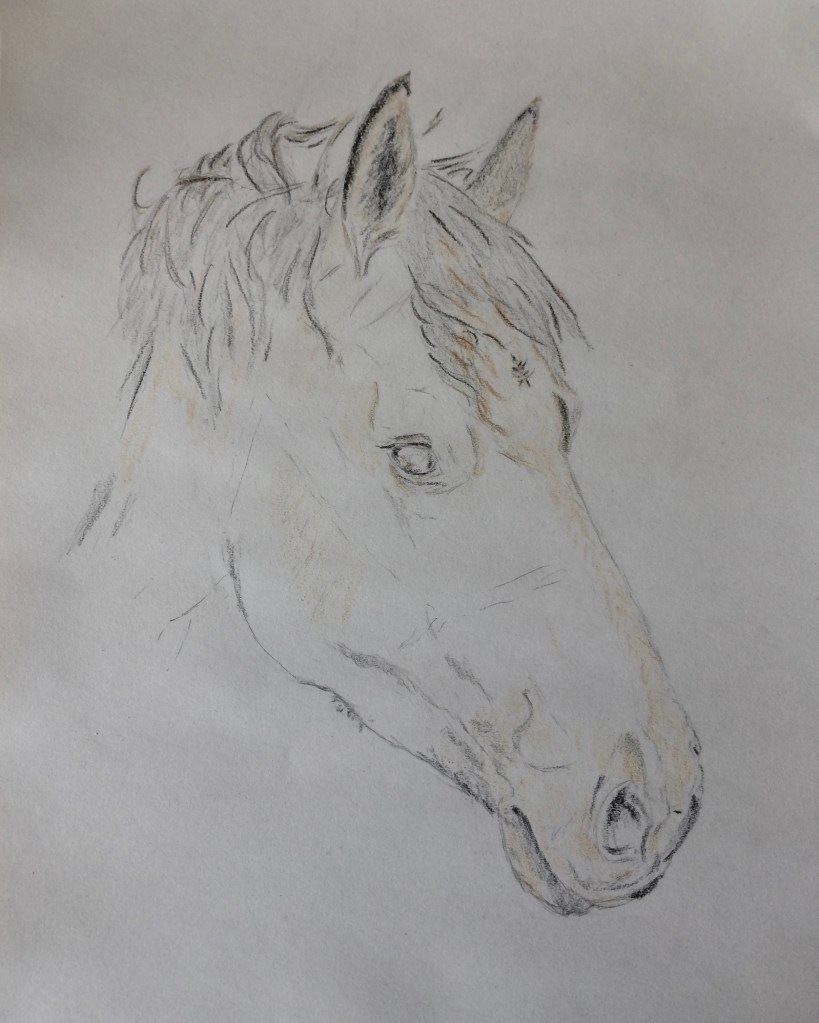
Being able to shape a behaviour is imperative for any trainer. Without the ability to read our minds, animals can’t offer us a perfect, exactly correct behaviour on the first try, especially when the training progresses to complicated movements. Instead, the trainer has a picture in mind of the end behaviour and progressively rewards behaviours closer and closer to the end goal. This is called ‘successive approximation’.

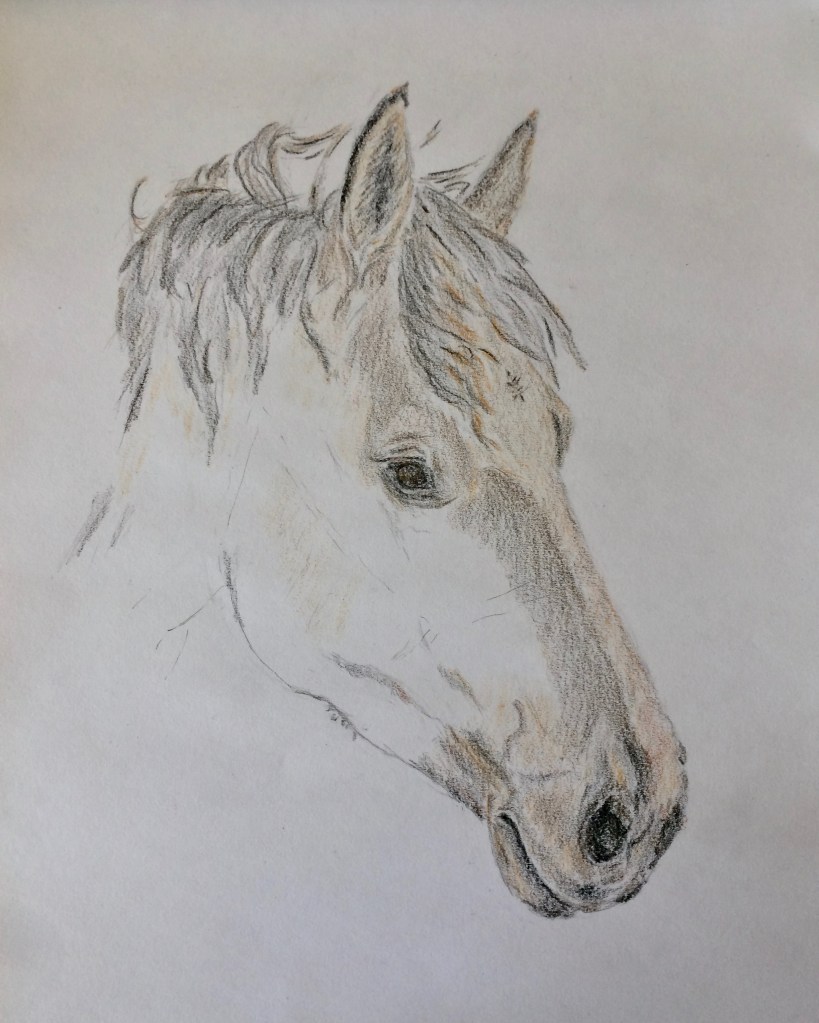
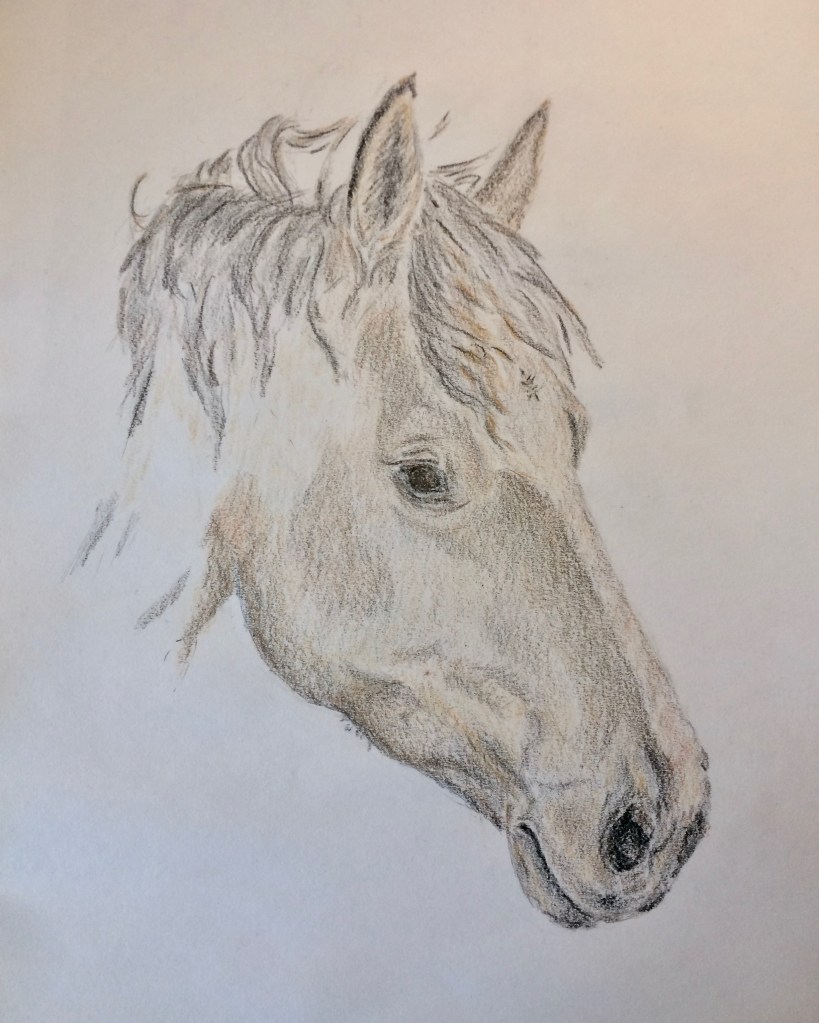
Artists use this too, and an analogy from art may make the art of shaping easier to understand.

The End Goal

When an artist begins work, there is a goal. This goal may be a photograph they are trying to emulate, or a picture in their head.

The trainer must also have a goal as specific as a photograph, down to the last detail. Where is the horse’s focus, where are the feet, what exactly starts the behaviour and what exactly stops it?

The Basic Attempt

The artist starts with a rough sketch. It is in the right direction, it has many of the characteristics of the photo, but is also very different. Only a few details are present, and only faintly. There is a lot of work to be done.

The trainer sees the horse begin to understand the basic concept and rewards the horse’s tries.

Obedience

In art, this stage is the one where I notice mistakes in the original pencil sketch. After putting it away for a day or two, I see things that don’t look quite right or aren’t proportional. I fix these as I move on to adding bolder outlines of the key areas.

In training, obedience is the level that breaks most often when something goes wrong in training. This is the level to come back to and refine from.

Rhythm

Each medium is different, but in art with coloured pencils you start with a base layer of the lightest colour to be found and progressively darken and shade from there.

In training, rhythm is the base layer, required for balance and cadence and willingness in any trained response.

Straightness

I don’t get the correct shade right away, and have to keep layering colours to produce the desired tone. Sometimes I have to go back to the base layer and add more in certain areas, sometimes using creativity when I am not getting quite the effect I want. There are often unexpected colours in a sketch. This one uses some blue and green!

This goes for training as well, when training rhythm in a movement, straightness is required to maintain it. When training straightness, rhythm is required to maintain it. Creative exercises help to progress this area of training.

Contact

Most places on the drawing are finished, or nearly so. Some refinement remains on the outline or key parts to make sure they stand out properly, and look just the way I want them.

Contact in training refines the last portions of the horse’s posture that have not yet fallen into place. Very often they are already partially present due to the previous correct training.

Proof

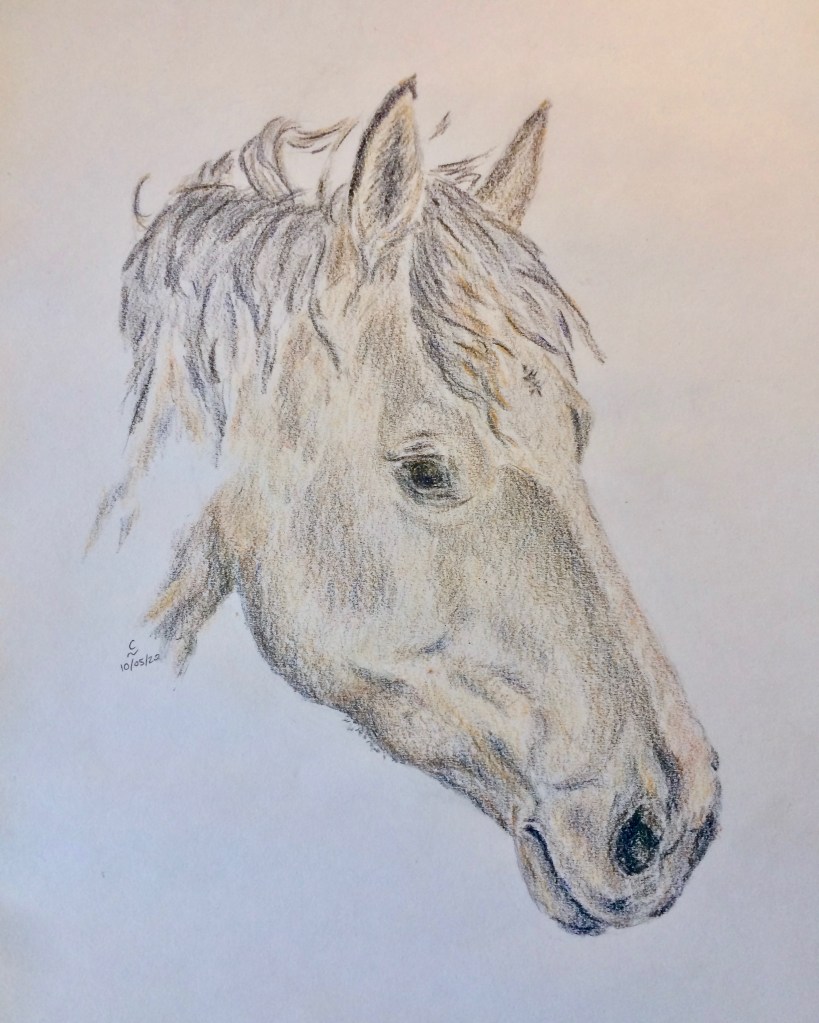
The drawing is complete. The last details are in place. The colour is true—and because the artist had a clear goal (photo) in the first place, the drawing is actually nicer than the original. The lighting is better, and there is no noisy background.

Shaping a behaviour slowly over time may actually give you a better result than you had pictured!

And that drawing of course is of Tesla, my beautiful mare.

Enjoyment Behaviours

[The following is a short excerpt from Week 2 of my new horse language course. In the course, week 2 includes 5 pages of summarized research, one journal article reading and three optional ones, two videos, and an assignment.]

I love getting enjoyment signals from a horse that I am working with, and I try to hunt for moments that the horse will enjoy, learning from each horse what they prefer individually. Positive affective states (roughly equivalent to optimism) have been shown to improve learning from training sessions, so actively looking for ways to improve my horse’s mood is good training practice.

We’ll start at the head and work through the body.

Head

Ears are a great indicator of the horse’s state of mind. Both ears must be relaxed to indicate full pleasure or enjoyment, if one is still hyper focused and stiff I keep working to find more relaxation. A relaxed ear position can be flopped slightly to the side (but a horse with ears stiffly flopped over like a donkey can indicate pain) or gently swivelling. 

The eyes shouldn’t have ‘worry wrinkles’ above them in the relaxed horse in a positive affective state. They may half close, but take care to consider the rest of the signals as half closed eyes can also indicate pain.

The nostril and lips are relaxed, not pinched into an angular shape.

When physical touch is particularly pleasurable, the horse will lean into it, move the body to put your hand in the right spot, and the upper lip begins to twitch and wiggle back and forth.

Neck

A neck position below the withers is the most calming position, as heart rate is lowered when the head is below wither level and pleasure hormones are released. During a pleasant grooming session, the horse may bulge his neck towards you to have you scratch harder, or bend his neck away to get a slightly different angle. 

Often for a hard-to-reach spot on my horse’s side, she will swing her neck around and indicate where she needs a scratch with a jerk of the nose. While I couldn’t find any research relevant to gesturing behaviour in horses yet, when I pay attention to where she might be trying to reach or perhaps point to, I often hit on a spot she really enjoys.

Legs

Relaxed muscle tone and a comfortable stance usually indicate calmness. Standing with one leg twisted or oddly positioned can be a fear/frozen stance or indicator of pain. It can take some practice to distinguish a ‘frozen’ horse that isn’t moving because it is avoiding a fear-inducing stimulus from a horse that is simply relaxed, which is why taking the entire body into account is important. Both the relaxed and the frozen horse may have a hind foot rested.

Tail

During movement, the tail should swing softly from side to side, creating an ‘s’ curve through its length, particularly visible at trot. Thrashing or switching the tail is the opposite of what we look for in calming signals, rather the tail will be held softly up or relaxed down, not clamped, nor pulled up and to one side (although this can be normal for some breeds, it is also an indication of pain).

Conclusion

Next time you are with your horse, watch for some of these behaviours. Spend a moment wondering what your horse is telling you while you handle or groom him, and try to hunt for some relaxing bonding time. When you notice a behaviour, good or bad, pause and think before reacting. See if you notice any of the behaviours that might indicate pain or discomfort and practice being attentive to your horse’s requests and cues.

Do you want to learn how to interpret your horse’s behaviour more accurately to forward your training efforts? I’m launching a six week online course in January 2023 to teach just that. Submit the RSVP below to be first to know when registration opens in December.

Go back

Your message has been sent

Warning
Warning
Do you want to be first to know when the horse language course opens?(required)

Warning
Warning.

Can We Be Horses?

Many natural horsemanship training methodologies suggest the handler interacts with the horse as if he were, himself, a horse. This is typically said to involve body language, trying to mimic how the ‘alpha mare’ would interact with an insubordinate horse.

Recent research looks at the equine ethogram (a list of defined behaviours that horses display) to determine if it is possible for humans to interact with horses as other horses would, and if horses interact with humans as they would with horses. This article is based on the 2009 review article by McGreevy, Oddie, Burton, and McLean: The horse–human dyad: Can we align horse training and handling activities with the equid social ethogram? Published by The Veterinary Journal v 181, pp 12-18.

Similarities

At first glance, it seems that many of the behaviours horses display towards each other in their social groups are also displayed towards humans and vice versa. Humans approach horses and touch them, with scratching around the withers being more relevant than patting or slapping. Humans move horses around with chasing pressure, and horses have been known to chase a human. Mutual grooming can be undertaken between a horse and a human. We push horses over in the tie stall, and horses sometimes push us. Leading a horse with no rein pressure looks similar to horses trekking together (traveling single file). Young horses can display snapping to humans. The list goes on, but the closer we get to the barn, the fewer the similarities become. By the time we are picking the horse’s feet and saddling up, the similarities are quickly vanishing.

Limitations

The most well known natural horsemanship training technique, round penning, is an excellent example of the limitations of trying to behave like a horse, and of interpreting the horse’s responses as if they were responding to another horse. Studies have shown that the behaviours typically understood to demonstrate ‘respect’ in the round pen (licking lips, head lowering, approaching the human) are context-specific. That means they are only shown towards the human in the round pen training setting, not during other interactions. Studies have also demonstrated that the effects of round penning may be achieved with a remote-controlled car instead of a human, showing that negative reinforcement and not respect may be at the root of round pen behaviour. (Remember, negative reinforcement doesn’t mean bad, it means something–like pressure–is taken away to reinforce behaviour.)

Thinking about horse behaviour as if we are horses can also lead to us expecting the horse to know what we want, and describing them in terms of ‘willingness to please’. Both of these are dangerous ways of thinking, as they ascribe more mental capacity to the horse than it actually has, and the implications of these two assumptions lie in their opposites: if the horse doesn’t do as we wanted right away, we assume he is being wilfully naughty, doesn’t respect us, and perhaps even wants to spite us. These assumptions can lead to punitive training methods, lowering training uptake and reducing welfare.

Conclusion

Similarities exist between horse-horse interactions and human-horse interactions, but these become disjointed the closer the human gets to riding, and fall apart completely when the horse is mounted to be ridden. If the foundation of the horse’s training on the ground relies on attempting to be a herd member, there will be no training to rely on once the trainer wants to get on, as the horse cannot possibly see a rider as being a member of its herd—there are no longer any social analogues.

Basing training on learning theory, while still taking into account the horse’s behaviour, and learning to interpret behavioural signals accurately instead of trying to interpret them as a horse, seems to be a more logical and effective training strategy.

Do you want to learn how to interpret your horse’s behaviour more accurately to forward your training efforts? I’m launching a six week online course in January 2023 to teach just that. Submit the RSVP below to be first to know when registration opens in December.

Go back

Your message has been sent

Warning
Warning
Do you want to be first to know when the horse language course opens?(required)

Warning
Warning.

What’s in a Training Method?

I used to think that dabbling in this method or that style would make me a really good rider and trainer.

What it made me was really confused.

Have you noticed the really good trainers and riders have a style all their own? Everyone then does interviews and articles, and watches them carefully, trying to copy them and create the same results. But it doesn’t work that way.

The many distinctive methods we see all around the world derive from what makes sense to the person who started it. All methods work on the exact same principles, or they wouldn’t work. Each horse and each trainer are individuals, and different words and phrases make sense to different people, so we get different ways of explaining things and different ways of creating behaviour.

That is why you can’t just watch someone and copy them. The great trainer has spent years filtering. They’ve worked out a system for processing all the opinions and styles that come their way, and choosing what they understand and what the horses they work with understand. So, you say, that’s what I need to do. Read and watch everything and filter it down to what works for me and my particular horse.

If only it were that simple. You’d need about 20 lifetimes to even scratch the surface of all the methods and ideas that are out there. That’s exactly why I got so confused. And that is exactly why I was so drawn to equitation science.

Equitation science is a filter. A system for evaluating what is going to work and what isn’t so you don’t have to try it all and end up just as confused as your horse has become due to your dabbling. There is always more to learn, and you can always learn something from everybody (even if it’s what not to do). But having a way to process all the information is a necessity, or you end up mired down in it all, unable to see your way clearly forward.

From years of research, there are certain things we know horses in general learn well from, and things that in general are best avoided because they are either ineffective or inhumane. Why not use that great body of knowledge acquired in previous generations to evaluate what is likely to work and what is likely not to before going and experimenting on your horse?

Now that I have been steeped in the equitation science world for a few years, patterns are starting to emerge. Each time I take in a training horse, I notice these patterns and can start to make predictions about what the horse might do next, and what my next training steps will be, and whether to just ignore a behaviour or work on it actively. Equitation science accelerated my ability to do this while I’m still relatively young. I don’t have to have lived 9 lives and gained all the experience myself. Andrew McLean and the other scientists who pioneered equitation science have done that before me.